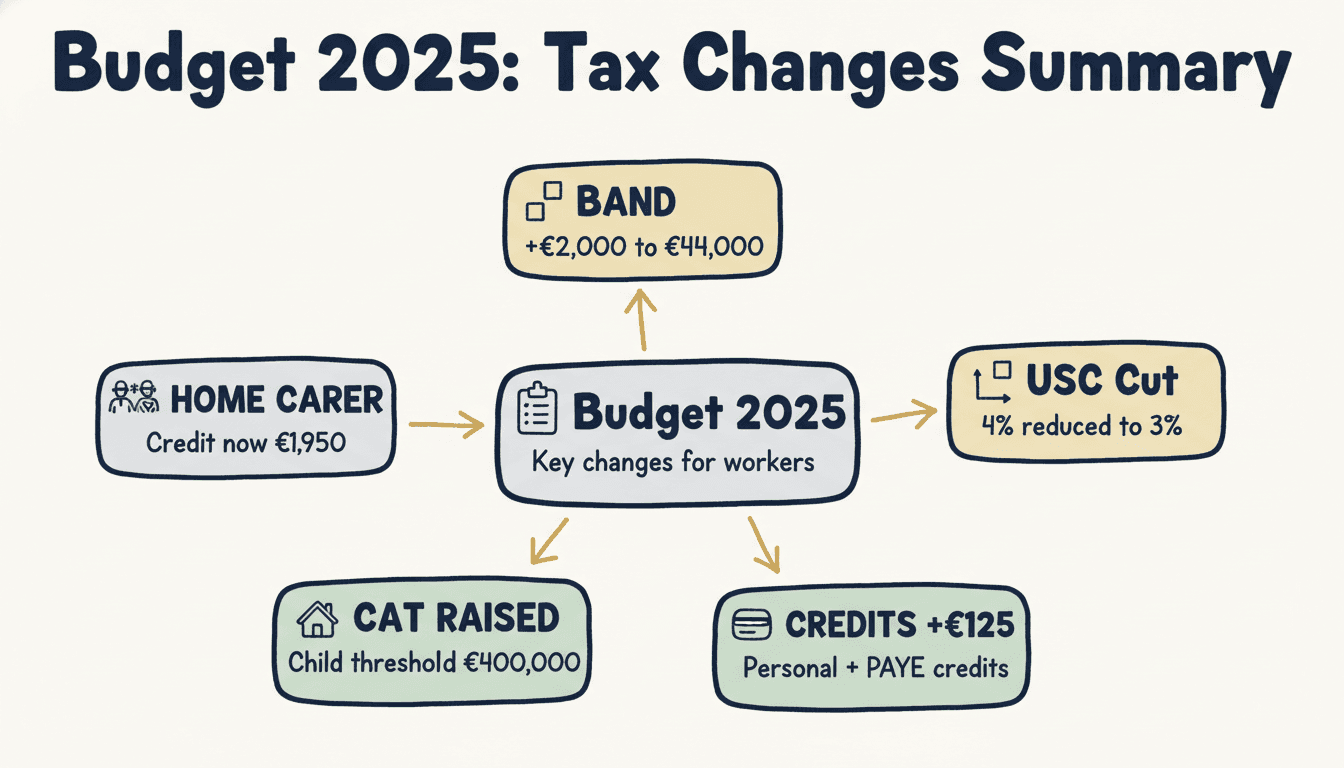
- The standard rate income tax band was raised to €44,000 for single people, saving up to €400 per year
- The 4% USC rate was cut to 3%, and the 2% band ceiling was widened from €25,760 to €27,382
- The personal, employee (PAYE), and earned income credits each increased by €125, worth €125 more in tax savings
Budget 2025, announced on 1 October 2024 by Minister for Finance Jack Chambers, contained a significant package of personal income tax measures. If you're a PAYE worker earning between €35,000 and €80,000, the combined effect of all these changes should leave you with noticeably more take-home pay each month. This guide breaks down every change that matters to individual taxpayers.
The Standard Rate Band Increase
The most important change in Budget 2025 for most workers is the increase in the standard rate band from €42,000 to €44,000 for a single person. This is the income threshold at which you transition from paying 20% income tax to paying 40%.
By raising this band by €2,000, the government is ensuring that an additional €2,000 of your income is taxed at 20% rather than 40%. The saving from this single measure alone is €400 per year (the 20-percentage-point difference applied to €2,000).
For married couples or civil partners with one income, the standard rate band rose from €51,000 to €53,000. Where both spouses work, the band is €53,000 for one spouse plus up to €35,000 for the second earner — a combined maximum of €88,000, up from €84,000 in 2024.
USC Rate Cut and Threshold Changes
The Universal Social Charge (USC) also became cheaper in Budget 2025. There were two changes: the 4% rate was cut to 3%, and the ceiling of the 2% band was widened by €1,622 (from €25,760 to €27,382), in line with the increase in the national minimum wage:
| 2024 Band | 2024 Rate | 2025 Band | 2025 Rate |
|---|---|---|---|
| €0 – €12,012 | 0.5% | €0 – €12,012 | 0.5% |
| €12,013 – €25,760 | 2% | €12,013 – €27,382 | 2% |
| €25,761 – €70,044 | 4% | €27,383 – €70,044 | 3% |
| Over €70,044 | 8% | Over €70,044 | 8% |
The USC exemption threshold was unchanged: if your total annual income is €13,000 or less, you pay no USC at all.
For someone earning €50,000, the combined effect of the rate cut and the wider 2% band saves approximately €259 per year, or just over €21 per month.
Tax Credits Increased
Three of the most widely-used tax credits were each increased by €125:
| Credit | 2024 Amount | 2025 Amount | Annual Saving |
|---|---|---|---|
| Personal Tax Credit | €1,875 | €2,000 | €125 |
| Employee (PAYE) Tax Credit | €1,875 | €2,000 | €125 |
| Earned Income Credit | €1,875 | €2,000 | €125 |
PAYE workers receive both the Personal and Employee Tax Credits, meaning the combined saving from these two increases alone is €250 per year.
Self-employed individuals receive the Personal Credit plus the Earned Income Credit, also saving €250.
Home Carer Tax Credit
For couples where one spouse stays at home to care for a child or other dependent, the Home Carer Tax Credit increased from €1,800 to €1,950 — a saving of €150 per year.
This credit is available to the earning spouse in a jointly-assessed couple where the carer's own income does not exceed €7,200 per year.
See the full guide: Home Carer Tax Credit Ireland 2025.
How Much Better Off Are You? A Worked Example
Let's take a PAYE worker earning €55,000 per year and calculate the combined impact of all Budget 2025 changes:
| Change | Annual Saving |
|---|---|
| Standard rate band increase (€2,000 × 20%) | €400 |
| USC changes (4% cut to 3%, plus wider 2% band) | €309 |
| Personal Tax Credit increase | €125 |
| Employee (PAYE) Tax Credit increase | €125 |
| Total annual saving | €959 |
That's almost €1,000 more per year, or roughly €80 extra per month in take-home pay. Use the Irish Tax Estimator income tax calculator to see the precise figure for your own salary.
Rent Tax Credit Increased
The Rent Tax Credit, introduced in Budget 2023 at €500, was increased in Budget 2025 from €750 to €1,000 per single renter (€2,000 for jointly assessed couples). The increase was also backdated to 2024, so renters can claim €1,000 (€2,000 for couples) for that year too. Eligible renters who haven't claimed it yet are leaving real money on the table. See the full guide: Ireland Rent Tax Credit 2025.
Inheritance and Gifts: CAT Thresholds Raised
Budget 2025 increased the Capital Acquisitions Tax (CAT) thresholds — the amounts you can receive as inheritance or a gift before tax kicks in:
- Group A (children receiving from parents): raised from €335,000 to €400,000
- Group B (nieces, nephews, siblings): raised from €32,500 to €40,000
- Group C (all others): raised from €16,250 to €20,000
If you're expecting to inherit property from a parent, this is a meaningful change. A child can now receive up to €400,000 tax-free.
PRSI: Already-Legislated Increases Continue
Budget 2025 introduced no new PRSI changes, but under the multi-year roadmap legislated in 2024, all PRSI rates rose by 0.1 percentage points from 1 October 2024 — taking the employee Class A rate from 4.0% to 4.1%. Further annual increases each October are already locked in (4.2% from October 2025, 4.35% from October 2026), to fund long-term social welfare commitments including keeping the State Pension age at 66.
What Should You Do Now?
The main actions from Budget 2025 are mostly automatic for PAYE workers — Revenue adjusts your tax credits and rate bands in your Tax Credit Certificate, and your employer applies them from January 2025. However, it's worth:
- Checking your Tax Credit Certificate via myAccount on Revenue.ie to confirm the updated credits have been applied
- Claiming the Rent Tax Credit if you rent privately and haven't done so yet
- Reviewing your pension contributions — the increased standard rate band makes pension contributions slightly more complex to optimise; see the Irish Tax Estimator pension guide
- Checking CAT implications if you have recently received or are expecting a significant inheritance
Use the Irish Tax Estimator income tax calculator to see your full 2025 take-home pay. For more guides on Irish personal tax, browse the Irish Tax Estimator blog.
Frequently Asked Questions
When do Budget 2025 tax changes take effect? Most income tax changes — the rate band, USC rates, and tax credits — took effect from 1 January 2025. PAYE workers should see them reflected in their pay from January 2025 onwards, once their employer updates their payroll based on Revenue's Tax Credit Certificate.
Will my employer automatically apply the new tax credits? Yes. Revenue issues updated Tax Credit Certificates to employers in December/January. Your employer applies these to your payroll automatically. You don't need to contact Revenue unless something looks wrong.
How do I check if my new credits have been applied? Sign in to myAccount on Revenue.ie and go to "Manage your Tax 2025." Check the tax credits listed. You should see the Personal Credit at €2,000 and the Employee Credit at €2,000.
I'm self-employed. Do the same changes apply? Most changes apply to self-employed people too — the standard rate band increase, USC rate cut, and the increase in the Personal and Earned Income Credits all benefit the self-employed. However, the changes take effect when you file your Form 11 for 2025, rather than through monthly payroll.
Are there any changes to mortgage interest relief in Budget 2025? Yes — the temporary Mortgage Interest Tax Relief scheme, introduced in Budget 2024 for homeowners whose mortgage balance was between €80,000 and €500,000 at 31 December 2022, was extended by one year in Budget 2025, so relief on interest paid in 2024 can be claimed in 2025. It is worth up to €1,250 per property. (Budget 2026 later extended it again, at a reduced cap of €625 for the final year.) Check Revenue.ie for eligibility details.
This article is for informational and estimation purposes only. It does not constitute professional tax advice. Tax rules can change. Always check Revenue.ie for the latest figures or consult a qualified tax advisor for your specific situation.
Written by a Chartered Accountant
All guides on Irish Tax Estimator are written and reviewed by a qualified Irish Chartered Accountant to ensure accuracy. This article is for general information only and does not constitute professional tax advice.
Share this guide