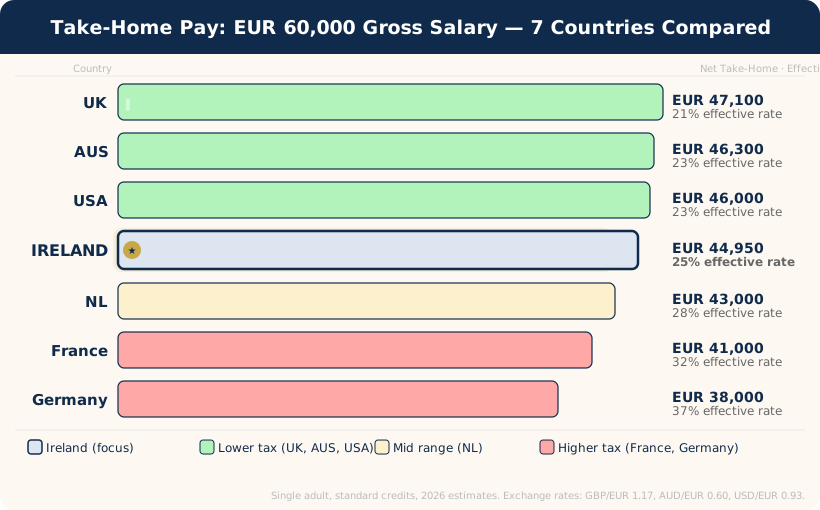
- On a €60,000 gross salary, Ireland's effective tax rate is approximately 25% — middle of the pack internationally
- Germany and France take significantly more, while the UK, USA and Australia tax somewhat less at this salary level
- Ireland's headline income tax rate of 40% looks high but most earners pay well below this as an effective rate
- Ireland's 40% band starting at just €44,000 — far lower than the UK's equivalent threshold — is what pushes the bill above the UK's at this level
One of the most common questions from professionals considering a move to Ireland — or negotiating a salary offer — is: "How does Irish tax compare to where I'm coming from?"
This guide gives you a direct, country-by-country comparison of take-home pay on a €60,000 equivalent gross salary, followed by an honest breakdown of where Ireland sits in the global picture.
The Comparison: €60,000 Gross Salary, 7 Countries
The table below shows the estimated annual net take-home pay for a single adult earning a €60,000 equivalent gross salary in each country, using 2026 rates. All figures are converted to Euro at approximate May 2026 exchange rates.
| Country | Gross (€ equiv.) | Net Take-Home (€) | Effective Tax Rate | Main Deductions |
|---|---|---|---|---|
| United Kingdom | €60,000 | ~€47,100 | ~21% | Income Tax 20/40%, National Insurance 8%/2% |
| Australia | €60,000 | ~€46,300 | ~23% | Income Tax (30% bracket), Medicare Levy 2% |
| United States | €60,000 | ~€46,000 | ~23% | Federal Income Tax, Social Security 6.2%, Medicare 1.45% (state tax varies) |
| Ireland | €60,000 | ~€44,925 | ~25% | Income Tax 20/40%, USC 0.5–8%, PRSI 4.2375% |
| Netherlands | €60,000 | ~€43,000 | ~28% | Income Tax (box 1 up to 49.5%, incl. social premiums) |
| France | €60,000 | ~€41,000 | ~32% | Income Tax, Social Charges (CSG/CRDS and contributions ~22%) |
| Germany | €60,000 | ~€38,000 | ~37% | Income Tax, Social Security ~21% (capped) |
Note: These are estimates for a single adult with no dependants and standard deductions. They exclude employer-side taxes. Exchange rates used: GBP/EUR 1.17, AUD/EUR 0.60, USD/EUR 0.93. Individual circumstances will vary.
How Does Ireland Stack Up?
Ireland sits in the middle of the pack — cheaper than Germany, France and the Netherlands, but more expensive than the UK, Australia, and the US at this salary level.
Where Ireland is More Expensive
The early 40% band is the difference-maker. Ireland's higher rate kicks in at €44,000 — in the UK, the equivalent 40% band only starts at £50,270 (roughly €58,800). The USC, applied on top of income tax with no direct equivalent in most other countries, adds to the gap.
For a €60,000 earner in 2026:
- Income Tax: €11,200 (after the €4,000 of standard credits)
- USC: ~€1,333
- PRSI: €2,543 (blended 4.2375%; 4.2% to 30 September 2026, then 4.35%)
- Total deductions: ~€15,075 (≈25%)
For a comparable UK earner on the same gross (≈£51,300):
- Income Tax: ~£7,950
- National Insurance: ~£3,040 (8% main rate since 2024, 2% above £50,270)
- Total deductions: ~£11,000 (≈€12,900, or ~21%)
The gap of roughly €2,100 a year is driven almost entirely by where the 40% band starts. Below about €45,000, Irish and UK take-home pay are much closer together.
Where the US Comparison Falls Short
The US figure looks attractive at ~23%, but that is the federal picture only. Add California state income tax (up to 13.3%), New York state tax (up to 10.9%) or Texas (0%), and the real effective rate varies from 23% to over 35% depending on where you live. Ireland's rate is fixed nationally.
What Ireland's Tax Pays For
Ireland's higher total deduction compared to the US includes:
- Universal public healthcare (through the HSE, free at point of use for many services)
- Free primary and secondary education
- Contributory State Pension (funded partly by PRSI)
- Paid maternity leave (26 weeks)
- Unemployment benefit (Jobseeker's Benefit)
The US equivalent of these — private health insurance, college tuition, private retirement savings — typically costs $15,000–$25,000 per year for a single adult. Factor that in and Ireland's "high tax" looks considerably more reasonable.
Ireland's Effective Rate vs the Headline Rate
A common misconception is that "Ireland has 40% income tax." That is the marginal rate — what you pay on your last euro earned if you're above the standard rate band. Your effective rate is much lower.
| Gross Salary | Effective Tax Rate (2026, single PAYE) |
|---|---|
| €30,000 | ~12% |
| €40,000 | ~16% |
| €50,000 | ~21% |
| €60,000 | ~25% |
| €80,000 | ~31% |
| €100,000 | ~35% |
Effective rate = total deductions ÷ gross salary. Includes Income Tax, USC and PRSI, after the standard Personal and PAYE credits.
Most Irish earners — even those well above the median salary of roughly €38,000 (the mean, pulled up by multinational salaries, is about €52,600) — pay an effective rate between 15% and 35%.
The USC: Ireland's Most Misunderstood Tax
The USC often gets blamed for making Ireland expensive, but it has been repeatedly cut. Budget 2025 reduced the 4% rate to 3%, and Budget 2026 widened the 2% band:
- The 2% band ceiling rose from €27,382 to €28,700 — meaning another €1,318 of income is taxed at 2% instead of 3%
- The rates themselves (0.5%, 2%, 3%, 8%) were unchanged in Budget 2026
The Budget 2026 USC change is worth about €13 per year to anyone earning €28,700 or more — modest, but it continues the downward trend. The bigger cut came a year earlier: Budget 2025's rate reduction from 4% to 3% saves a €60,000 earner roughly €330 per year.
Use the Calculator to See Your Own Picture
The comparison above uses simplified assumptions. Your actual take-home depends on:
- Your marital status (married couples benefit from a wider standard rate band)
- Pension contributions (pension relief reduces your taxable income)
- Tax credits (rent credit, home carer credit, age credit)
- Medical card status
Use the Irish Tax Estimator to get your personalised figure:
➡️ Calculate Your Irish Take-Home Pay →
Or see how Budget 2026 specifically affects you:
➡️ Budget 2026 Before & After Comparison →
Frequently Asked Questions
Is Ireland a high-tax country? By European standards, Ireland is moderate. It is significantly cheaper than Germany, France, Belgium, and the Nordic countries. It is more expensive than the UK, Australia, and the US — but offers broader public services than the US and comparable services to the UK.
Why does Ireland have USC on top of income tax? The USC was introduced in 2011 during the financial crisis to broaden the tax base and ensure everyone with an income above €13,000 contributes something. It has been cut repeatedly since then and was again reduced in Budget 2026.
Is it worth negotiating gross salary in Ireland? Yes — especially above €44,000 where the 40% income tax rate kicks in. Use our reverse salary calculator to find what gross you need to achieve your target take-home.
Can I reduce my Irish tax bill legally? Yes. The most effective methods are: (1) pension contributions — you get income tax relief at your marginal rate; (2) claiming all tax credits you are entitled to via Revenue myAccount; (3) claiming WFH relief if you work from home. Use our WFH tax relief calculator to estimate what you can reclaim.
Written by a Chartered Accountant
All guides on Irish Tax Estimator are written and reviewed by a qualified Irish Chartered Accountant to ensure accuracy. This article is for general information only and does not constitute professional tax advice.
Share this guide