- Married couples where one spouse cares for a child or dependent can claim up to €1,950 off their income tax bill in 2025
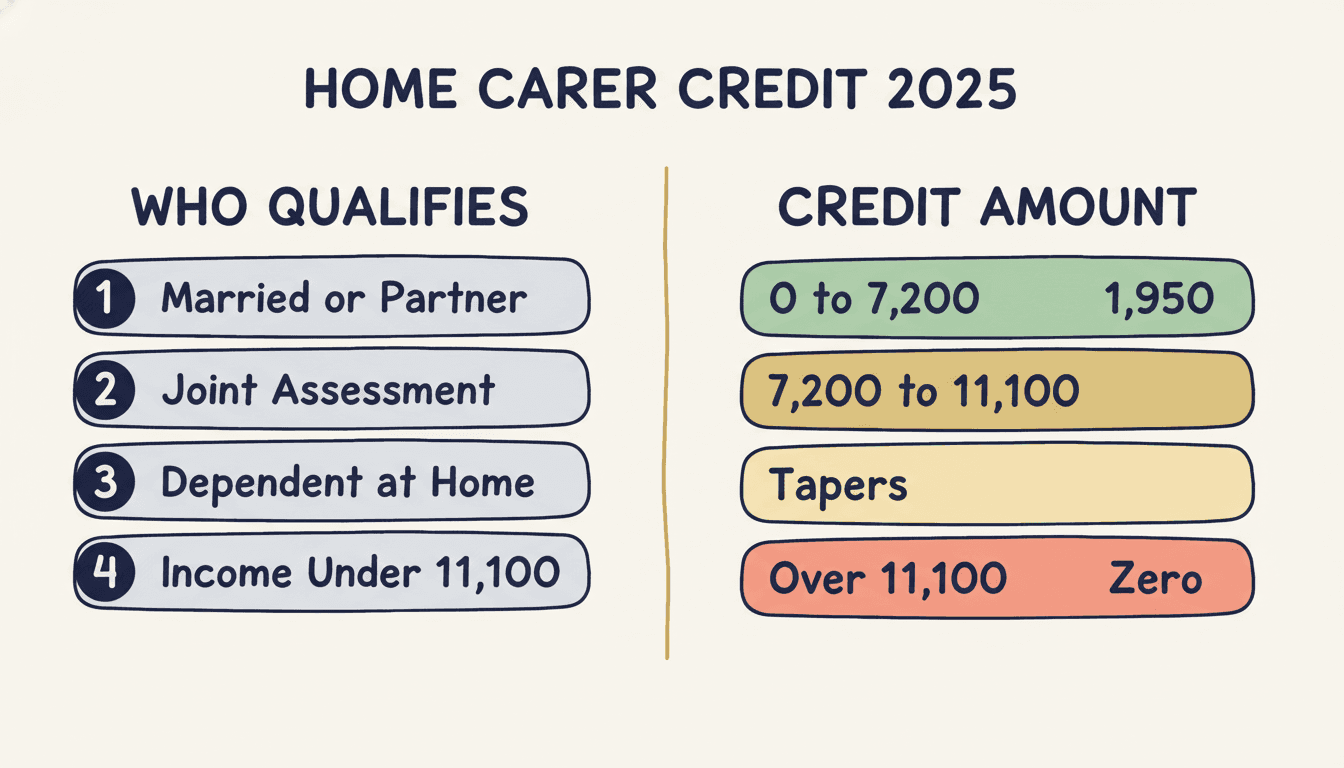
- The credit is available in full if the home carer earns €7,200 or less — it tapers to zero at €11,100
- Claim through Revenue myAccount in about 10 minutes — you can backdate for up to four prior tax years
The Home Carer Tax Credit is one of the most consistently under-claimed reliefs in the Irish tax system. Each year, a significant number of married couples who qualify never make the claim — effectively donating €1,950 to Revenue by omission. If one spouse or civil partner stays at home to care for a child or other dependent, there is a very good chance you are entitled to this credit. This guide explains exactly who qualifies, how much you can claim, and the precise steps to claim it through Revenue myAccount.
What Is the Home Carer Tax Credit?
The Home Carer Tax Credit is a tax relief for married couples (and civil partners) in Ireland where one spouse acts as a home carer for a qualifying dependent. Rather than reducing your taxable income, it reduces your actual income tax bill euro for euro. In 2025, the credit is worth up to €1,950 per year.
The credit was introduced to recognise the economic contribution of a spouse who leaves or reduces paid employment to care for a dependent — typically a young child or an elderly or incapacitated family member. It is claimed by the working spouse (or the assessable spouse under joint assessment) against their income tax liability.
Who Qualifies? The Four Conditions
To claim the Home Carer Tax Credit in 2025, all four of the following conditions must be met:
1. You must be married or in a civil partnership
The credit is only available to married couples and registered civil partners. Cohabiting couples who are not married do not qualify. Widowed persons who have a dependent child may also qualify for a related relief — the Single Person Child Carer Credit — though this is a separate credit with different rules.
2. You must be jointly assessed by Revenue
Joint assessment is the tax assessment basis that allows married couples to pool their tax credits and standard rate band. It is the basis Revenue applies by default once you register your marriage with them — but if you have never told Revenue you are married, or have opted for separate treatment, you will not qualify. You can check or change your basis of assessment any time through myAccount. Most couples with unequal incomes benefit from joint assessment regardless of whether they claim the Home Carer Credit.
3. There must be a qualifying dependent in the home
A qualifying dependent is one of the following:
- A child for whom Child Benefit is payable (or would be payable if the child were young enough — for example, a child aged 18 or over who is in full-time education or who has a disability)
- An incapacitated adult who is being maintained at your own expense and who lives with you or who you are contributing substantially to the care of
- A person aged 65 or over who lives with you and is related to you or to your spouse (parent, grandparent, uncle, aunt, sibling, etc.)
For most families with young children, the first category covers them straightforwardly. The child does not need to be your biological child — an adopted child or a child you are fostering may also qualify.
4. The home carer's income must be below €11,100
This is the income condition that most people think will disqualify them, but for many carers who work part-time or are not earning at all, it is not an issue. The full credit of €1,950 is available where the carer's income does not exceed €7,200 per year. Above that, the credit tapers — see the next section.
How Much Is the Credit Worth in 2025?
The maximum credit is €1,950 in 2025. It is applied directly against your income tax bill, so if your income tax liability before credits is €12,000, claiming the Home Carer Credit reduces it to €10,050.
| Home Carer's Income | Tax Credit Available |
|---|---|
| €0 – €7,200 | Full €1,950 |
| €8,000 | €1,550 |
| €9,000 | €1,050 |
| €10,000 | €550 |
| €11,000 | €50 |
| €11,100 or more | Nil |
If the home carer has no income at all — for example, a parent who left work to care for a newborn — the full €1,950 credit applies with no calculation needed.
The Income Tapering Rule Explained
Once the home carer's income exceeds €7,200, the credit is reduced by €1 for every €2 of income above that threshold. The calculation is:
Credit = €1,950 − ((Carer's Income − €7,200) ÷ 2)
The credit reaches zero when the carer's income hits €11,100 (since €1,950 × 2 = €3,900, and €7,200 + €3,900 = €11,100).
Example: Niamh works part-time and earns €9,000 in 2025.
- Income over threshold: €9,000 − €7,200 = €1,800
- Credit reduction: €1,800 ÷ 2 = €900
- Reduced credit: €1,950 − €900 = €1,050
Niamh's household still claims €1,050 off their income tax bill — worth having.
When estimating whether you qualify and how much you can claim, the Irish Tax Estimator income tax calculator can help you model your overall tax position for 2025.
Home Carer Credit vs Increased Standard Rate Band: Which to Choose?
This is the one decision point that can trip couples up. Revenue's rules state that you cannot claim both the Home Carer Tax Credit and the Increased Standard Rate Band for the same tax year.
The Increased Standard Rate Band allows a working spouse to use up to €9,000 of the home carer's unused standard rate band, saving up to €1,800 in income tax (€9,000 × 20%). This only applies if the home carer has some employment income, because you can only transfer the portion of the rate band that the carer is not themselves using.
When the Home Carer Credit is better:
- The home carer has no income, or earns €7,200 or less. The full credit of €1,950 exceeds the maximum Increased Rate Band benefit of €1,800.
- The home carer earns modest income and the reduced credit still beats €1,800.
When the Increased Rate Band might be better:
- The home carer earns between roughly €8,900 and €11,100 — the tapered credit may be worth less than the potential band transfer.
- You should calculate both options for your exact income figures.
In practice, the majority of couples where one spouse is a full-time carer or earns very little are better off with the Home Carer Credit. Revenue will not automatically select the more beneficial option — you must claim the one you want. If you are unsure, it is worth running the numbers or taking advice.
Worked Example: How Much Can a Family Save?
Scenario: Seán (€68,000 salary, PAYE) and Aoife (stay-at-home parent, no income), jointly assessed, one child aged 3
Aoife earns nothing, so Seán claims the full Home Carer Tax Credit of €1,950.
| Item | Amount |
|---|---|
| Seán's gross income | €68,000 |
| Standard rate band (married, one income) | €53,000 @ 20% |
| Higher rate income | €15,000 @ 40% |
| Gross income tax | €10,600 + €6,000 = €16,600 |
| Less: Married Person's Tax Credit | −€4,000 |
| Less: PAYE Tax Credit | −€2,000 |
| Less: Home Carer Tax Credit | −€1,950 |
| Income tax payable | €8,650 |
Without the Home Carer Tax Credit, Seán's income tax would be €10,600. The credit saves the family €1,950 per year — money that Revenue returns or adjusts on the tax certificate.
How to Claim the Home Carer Tax Credit
Claiming takes about 10 minutes through Revenue's myAccount service. There is no form to post and no tax advisor required.
Step 1: Sign in to myAccount Go to myaccount.revenue.ie and sign in. Register first if you haven't already — you'll need your PPS number, date of birth, and a phone number or email address.
Step 2: Go to "Manage Your Tax Credits" From the myAccount dashboard, select "Manage Your Tax" and then "Claim tax credits." Under the credits listed, find "Home Carer Tax Credit."
Step 3: Confirm your details You'll be asked to confirm:
- That you are jointly assessed with your spouse
- That your spouse or partner's income is below the relevant threshold
- Details of the qualifying dependent (usually just confirming child benefit is in payment)
Step 4: Submit Revenue will adjust your tax credit certificate and either reduce your PAYE deductions going forward or refund any tax overpaid in the current year. Refunds are typically paid directly to your bank account.
Revenue's Home Carer Credit page on Revenue.ie has the full official conditions for your specific situation.
Can You Backdate the Claim?
Yes — and this is where the real opportunity lies if you have never claimed before.
Revenue allows you to backdate claims for income tax for up to four years from the end of the relevant tax year. As of 2026, you can still claim the Home Carer Credit for:
- 2025 (in-year or after year end)
- 2024 (backdate via myAccount)
- 2023 (backdate via myAccount)
- 2022 (backdate via myAccount)
If the credit was available in each of those years (i.e., you had a qualifying dependent and met the income conditions), you could be owed up to €7,050 across four years (€1,600 for 2022, €1,700 for 2023, €1,800 for 2024 and €1,950 for 2025), depending on your circumstances.
To backdate, sign in to myAccount, select "Review Your Tax" for each prior year individually, and claim the credit for each one. Any refunds will be processed and paid to your bank account.
Frequently Asked Questions
Can we claim the Home Carer Credit even though our child has started school? Yes. The credit is linked to whether Child Benefit is payable, not whether the child is in full-time childcare. A school-going child under 16 still qualifies their parent for Child Benefit, so the Home Carer Credit can still be claimed as long as the other conditions are met.
Both my spouse and I are on PAYE. Can we still claim? The Home Carer Credit is intended for situations where one spouse is primarily at home, so if your spouse has significant employment income you may be in the tapering zone. However, if your spouse works part-time and earns under €11,100, you can still claim a partial or full credit depending on their income. Remember that you cannot also claim the Increased Rate Band benefit if you claim the Home Carer Credit.
My spouse cares for my elderly parent who lives with us. Does that qualify? Yes. An incapacitated adult being maintained at the carer's expense, or a person aged 65 or over who lives with you and is related to you or your spouse, is a qualifying dependent for the Home Carer Credit. The dependent does not need to be a child.
We got married this year. Can we claim the Home Carer Credit for 2025? You can elect for joint assessment from the year of marriage. Once jointly assessed, you can claim the Home Carer Credit for the remainder of 2025 from your marriage date. Revenue will calculate the credit on a pro-rata basis and refund any overpaid tax.
What if my spouse receives Carer's Allowance from the Department of Social Protection? Good news: Carer's Allowance and Carer's Benefit are not taken into account when working out the home carer's income for this credit (although they remain taxable sources of income). So a carer whose only income is Carer's Allowance still qualifies for the full €1,950 credit. Only other income — such as part-time earnings — counts towards the €7,200 threshold.
This article is for informational and estimation purposes only. It does not constitute professional tax advice. Tax rules can change. Always check Revenue.ie for the latest figures or consult a qualified tax advisor for your specific situation.
Written by a Chartered Accountant
All guides on Irish Tax Estimator are written and reviewed by a qualified Irish Chartered Accountant to ensure accuracy. This article is for general information only and does not constitute professional tax advice.
Share this guide