- The USC 2% band ceiling rose from €27,382 to €28,700 — saving workers above that threshold up to €13 per year
- Income tax bands and tax credits were left unchanged from 2025 (€44,000 standard rate band, €2,000 personal and PAYE credits)
- A new zero-emission vehicle BIK category (A1) was introduced, and the fund exit tax was cut from 41% to 38%
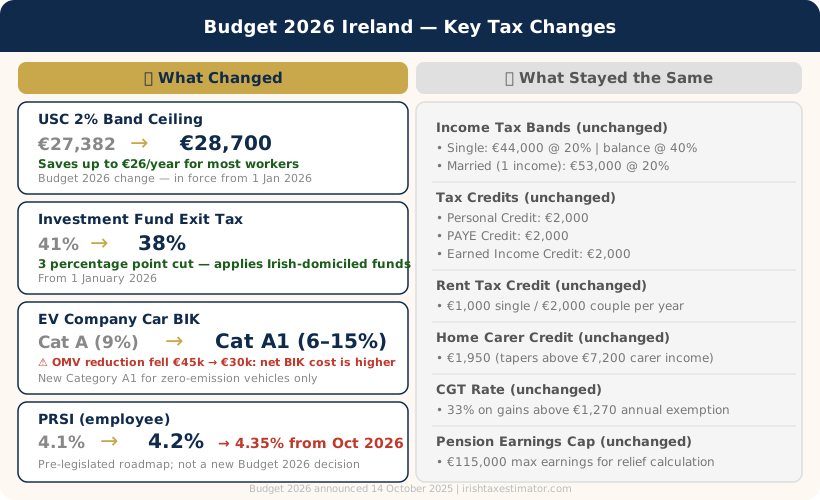
Budget 2026, announced on 14 October 2025 by Minister for Finance Paschal Donohoe, took a more targeted approach than the sweeping changes of Budget 2025. The headline income tax measures — standard rate band, personal credits, and PAYE credits — were held unchanged from 2025. The meaningful changes are in USC, electric vehicle BIK, and investment fund taxation. This guide breaks down every change that matters to individual taxpayers. If you just want the bottom line for your own salary, use our Budget 2026 take-home pay calculator for a side-by-side 2025 vs 2026 comparison.
What Stayed the Same in 2026
Before covering the changes, it's worth knowing what did not change. For many workers, their income tax structure is identical to 2025:
| Item | 2025 | 2026 | Change |
|---|---|---|---|
| Standard rate band (single) | €44,000 | €44,000 | Unchanged |
| Standard rate band (married, one income) | €53,000 | €53,000 | Unchanged |
| Personal Tax Credit | €2,000 | €2,000 | Unchanged |
| PAYE (Employee) Tax Credit | €2,000 | €2,000 | Unchanged |
| Earned Income Credit | €2,000 | €2,000 | Unchanged |
| Rent Tax Credit | €1,000 | €1,000 | Unchanged |
| Home Carer Tax Credit | €1,950 | €1,950 | Unchanged |
| Pension earnings cap | €115,000 | €115,000 | Unchanged |
USC: 2% Band Widened to €28,700
The one meaningful change to personal taxation in Budget 2026 is the widening of the USC 2% band ceiling from €27,382 to €28,700 — an increase of €1,318, in line with the national minimum wage increase. The rates themselves are unchanged.
| Band | 2025 Ceiling | 2026 Ceiling | Rate |
|---|---|---|---|
| First band | €12,012 | €12,012 | 0.5% |
| Second band | €27,382 | €28,700 | 2% |
| Third band | €70,044 | €70,044 | 3% |
| Above | — | — | 8% |
For anyone earning above €28,700, the saving from this change is €13.18 per year — the additional €1,318 of income that moved from the 3% band to the 2% band. This is modest, but automatic: Revenue adjusts your credits with no action needed from you.
The USC exemption threshold (total income of €13,000 or less) remains unchanged.
PRSI: Scheduled Roadmap Continues
Budget 2026 introduced no new PRSI changes, but the multi-year roadmap legislated previously continues:
- From 1 October 2025: employee Class A PRSI rose from 4.1% to 4.2% (already in force at the time of Budget 2026)
- From 1 October 2026: employee Class A PRSI rises from 4.2% to 4.35%
For 2026 estimation purposes, 4.2% is the rate for January to September and 4.35% applies from October. Because the rate changes mid-year, the correct full-year figure is the blended 4.2375% — the rate Revenue applies to 2026 annual income under self-assessment, and the one the Irish Tax Estimator uses.
For a worker earning €50,000, the 2026 PRSI bill is approximately €2,119 per year (blended 4.2375% × €50,000), compared with about €2,063 in 2025 (using the blended 4.125% rate for that year).
Net Change for a Typical PAYE Worker in 2026
For a PAYE worker earning €55,000, the combined effect of Budget 2026 changes:
| Change | Annual Impact |
|---|---|
| USC band widening (saving ~€13) | +€13 |
| PRSI increase (blended 4.125% → 4.2375%) | −€62 |
| Net change | −€49 per year |
Most workers will see a very slight net reduction in take-home pay in 2026 — the PRSI increase outweighs the USC band saving by about €49 for a €55,000 salary. For lower-income workers below €27,382, only the PRSI increase applies, so they are marginally worse off.
Use our Budget 2026 comparison tool to see the precise 2025 vs 2026 figures side by side for your own salary.
Electric Vehicle BIK: New Category A1
One of the more significant structural changes in Budget 2026 is the introduction of a new BIK category — Category A1 — for zero-emission vehicles (pure electric cars). This replaces the treatment of EVs under the old Category A.
The EV-specific OMV reduction dropped from €35,000 to €20,000 in 2026 (total reduction including the €10,000 universal element is €30,000, down from €45,000 in 2025). The new A1 category has lower BIK rates than Category A:
| Annual Business Mileage | Category A1 (Zero-Emission, 2026) |
|---|---|
| 0 – 26,000 km | 15% |
| 26,001 – 39,000 km | 12% |
| 39,001 – 48,000 km | 9% |
| 48,001 km + | 6% |
A €55,000 EV in 2026 generates BIK of €3,750 (€25,000 adjusted OMV × 15%), compared with €2,250 in 2025 — higher effective cost despite the lower rates, because the OMV reduction shrank from €45,000 to €30,000. See the full Electric Vehicle BIK guide for 2026.
Fund Exit Tax: Cut from 41% to 38%
For investors in Irish-domiciled investment funds, ETFs, and life assurance investment products, Budget 2026 reduced the exit tax rate from 41% to 38% with effect from 1 January 2026. Exit tax applies on gains within these fund structures on maturity, withdrawal, or deemed disposal events (every 8 years).
The cut benefits anyone who made gains in Irish-domiciled funds or investment products in 2026 or later. Gains from direct share purchases are still subject to CGT at 33%, which is unchanged.
What Should You Do Now?
For most PAYE workers, Budget 2026 requires no action — the USC band change is applied automatically by Revenue through your Tax Credit Certificate. However, it's still worth:
- Checking your Tax Credit Certificate via myAccount on Revenue.ie to confirm credits are correct for 2026
- Claiming the Rent Tax Credit if you rent privately and haven't claimed for 2025 or earlier years
- Reviewing pension contributions — the earnings cap and age-based limits are unchanged, so the same planning applies
- Checking EV BIK implications if you drive a company electric vehicle, since 2026 sees higher effective BIK costs despite lower category rates
Use the Irish Tax Estimator income tax calculator to see your full 2026 take-home pay. For more guides on Irish personal tax, browse the Irish Tax Estimator blog.
Frequently Asked Questions
Did income tax bands change in Budget 2026? No. The standard rate band remained at €44,000 for a single person and €53,000 for a married couple with one income. The 20% and 40% rates are unchanged.
Did tax credits increase in Budget 2026? No. The personal tax credit (€2,000), PAYE credit (€2,000), and earned income credit (€2,000) are all unchanged from 2025. The rent tax credit remains at €1,000 and the home carer credit remains at €1,950.
When do Budget 2026 tax changes take effect? Most changes took effect from 1 January 2026. The PRSI increase to 4.35% takes effect on 1 October 2026. PAYE workers saw the USC band change applied from January 2026 through their updated Tax Credit Certificate.
I'm self-employed. Do the same changes apply? Yes. The USC band change applies to all taxpayers. The PRSI roadmap applies to Class S (self-employed) PRSI at the same rate schedule as Class A.
What happened to mortgage interest relief? The temporary Mortgage Interest Tax Relief reached its final year in Budget 2026 with a reduced cap of €625 per property (down from €1,250 in 2025). Check Revenue.ie for eligibility details.
This article is for informational and estimation purposes only. It does not constitute professional tax advice. Tax rules can change. Always check Revenue.ie for the latest figures or consult a qualified tax advisor for your specific situation.
Written by a Chartered Accountant
All guides on Irish Tax Estimator are written and reviewed by a qualified Irish Chartered Accountant to ensure accuracy. This article is for general information only and does not constitute professional tax advice.
Share this guide