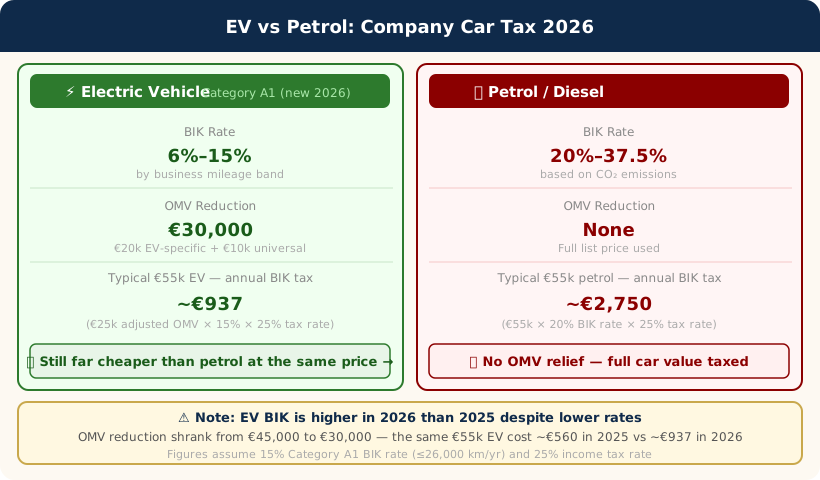
- In 2026, electric company cars are in the new Category A1, with BIK rates of 6%–15% depending on business mileage
- The total OMV reduction for EVs dropped from €45,000 in 2025 to €30,000 in 2026 (€20,000 EV-specific + €10,000 universal)
- A €55,000 EV in 2026 generates BIK on €25,000 of value, up from €10,000 in 2025 — higher absolute BIK cost despite lower rates
Company car tax — Benefit-in-Kind (BIK) — underwent further change in Ireland for 2026. Budget 2026 introduced a new Category A1 specifically for zero-emission vehicles, with lower BIK rates than the old Category A — but the EV-specific OMV reduction also shrank from €35,000 to €20,000. The net effect is that most EV drivers face higher BIK bills in 2026 than in 2025, even though the rates are lower. If you drive a company electric car, understanding the 2026 rules is essential.
What Is Benefit-in-Kind on a Company Car?
If your employer provides you with a company car that you also use for personal journeys (including commuting), Revenue treats the personal use as a taxable benefit. The value of this benefit — the Benefit-in-Kind (BIK) — is added to your salary and taxed as income.
BIK is not a separate tax. It's treated as employment income, so you pay income tax, USC, and PRSI on it at your normal marginal rates. The BIK amount itself is added to your P60 and reflected in your total income for the year.
How Is Company Car BIK Calculated in 2026?
The BIK calculation has two components:
1. Original Market Value (OMV) after reductions This is the list price of the car when new, including VAT and VRT, minus any applicable OMV reductions. For EVs in 2026: total reduction of €30,000 (€20,000 EV-specific + €10,000 universal reduction for all Categories A–D).
2. BIK Rate (based on CO2 emissions category AND business mileage) Revenue assigns each car to an emissions category, and the BIK rate depends on how much annual business mileage you do. From 2026, zero-emission vehicles use the new Category A1 with lower rates.
Category A1 — Zero-Emission Vehicles (New for 2026)
| Annual Business Mileage | Category A1 Rate |
|---|---|
| 0 – 26,000 km | 15% |
| 26,001 – 39,000 km | 12% |
| 39,001 – 48,000 km | 9% |
| 48,001 km + | 6% |
Other Categories (Unchanged)
| Annual Business Mileage | B (59–99 g CO2) | C (99–139) | D (139–179) | E (180+) |
|---|---|---|---|---|
| 0 – 26,000 km | 26.25% | 30% | 33.75% | 37.5% |
| 26,001 – 39,000 km | 21% | 24% | 27% | 30% |
| 39,001 – 48,000 km | 15.75% | 18% | 20.25% | 22.5% |
| 48,001 km + | 10.5% | 12% | 13.5% | 15% |
Formula: BIK = (OMV minus reductions) × BIK Rate
The EV OMV Reduction Schedule
The EV-specific reduction is tapering down each year:
| Year | EV-Specific Reduction | Universal Reduction (cats A–D) | Total for an EV |
|---|---|---|---|
| 2023 – 2025 | €35,000 | €10,000 | €45,000 |
| 2026 | €20,000 | €10,000 | €30,000 |
| 2027 | €10,000 | €5,000 | €15,000 |
| 2028 | Nil | €2,500 | €2,500 |
2026 EV BIK Worked Example
EV with OMV of €55,000, under 26,000 business km per year:
| Amount | |
|---|---|
| OMV | €55,000 |
| Less EV + universal reductions | –€30,000 |
| Adjusted OMV | €25,000 |
| BIK Rate (Category A1, lowest mileage band) | 15% |
| BIK value | €3,750 |
| Income tax + USC + PRSI at ~47% combined (standard earner) | ~€1,763 per year |
| Monthly BIK cost to employee | ~€147 |
Compare 2025 vs 2026 for the same €55,000 EV:
| 2025 | 2026 | |
|---|---|---|
| OMV after reductions | €10,000 (€45,000 off) | €25,000 (€30,000 off) |
| BIK Rate | 22.5% (Category A) | 15% (Category A1) |
| BIK value | €2,250 | €3,750 |
| Employee tax cost (~47%) | ~€1,058/yr | ~€1,763/yr |
The new lower A1 rates partially offset the smaller OMV reduction, but not fully — EV drivers pay roughly €705 more in BIK tax in 2026 than 2025 for the same vehicle.
When Does an EV Generate Zero BIK?
With a €30,000 total reduction in 2026, an EV with an OMV of €30,000 or less still generates zero BIK — the reduction wipes out the entire taxable value. EVs above €30,000 OMV will have some BIK.
EV vs Petrol: Still Worth It in 2026?
Even with higher BIK than 2025, EVs remain far more tax-efficient than petrol or diesel cars at the same price point.
Quick Comparison: Same OMV (€50,000), same salary (€75,000), under 26,000 business km
| EV (Category A1) | Petrol Category D | |
|---|---|---|
| OMV after reductions | €20,000 | €40,000 |
| BIK Rate | 15% | 33.75% |
| Annual BIK value | €3,000 | €13,500 |
| Extra tax to employee (~47%) | ~€1,410/yr | ~€6,345/yr |
| Difference | ~€4,935/yr less for EV |
An EV company car driver saves nearly €5,000 per year in tax compared with an equivalent petrol car.
Business Mileage Still Matters
Even under Category A1, the amount of business mileage you drive directly reduces your BIK rate. An EV driver doing over 48,001 km of genuine business travel per year pays just 6% on the reduced OMV, compared with 15% for a low-mileage driver of the same car. Records of business mileage must be kept (date, journey, purpose, odometer readings) to support the reduction if Revenue audits.
Home Charging: BIK on Charging Equipment
The provision and installation of a home charger by an employer for an employee's EV company car is not a BIK, provided the charger is for the business vehicle. This exemption continues in 2026.
Use the Irish Tax Estimator income tax calculator to model your overall income tax position including BIK additions.
Frequently Asked Questions
What if I give back my company car — does BIK still apply? BIK is calculated based on the period of availability. If you surrendered the car partway through the year, Revenue pro-rates the BIK to the months the car was available to you.
Does BIK apply even if I don't use the car for personal journeys? Revenue's default position is that a company car available to an employee involves some element of personal use. If you can demonstrate that the car is solely for business use and is kept at the business premises overnight with no personal use, BIK may not apply — but this is rarely accepted in practice without very strong evidence.
I drive my own car for work and get mileage reimbursements. Does BIK apply? No. Mileage reimbursements on your own car are not a BIK. Revenue allows employers to reimburse business mileage tax-free using the civil service mileage rates. Amounts above the approved rates are taxable.
My company car is a pool car used by multiple people. Is BIK still charged? Pool cars used by multiple employees are generally exempt from BIK, provided no single employee has the car available to them for more than 60% of working days and the car is kept at the business premises when not in use.
Will EV BIK relief disappear entirely after 2026? No — it tapers further. In 2027, EVs get a €10,000 EV-specific reduction plus the €5,000 universal reduction (€15,000 total), falling to just €2,500 in 2028. Category A1 rates continue to apply in those years, which softens the impact of the smaller OMV reductions.
This article is for informational and estimation purposes only. It does not constitute professional tax advice. Tax rules can change. Always check Revenue.ie for the latest figures or consult a qualified tax advisor for your specific situation.
Written by a Chartered Accountant
All guides on Irish Tax Estimator are written and reviewed by a qualified Irish Chartered Accountant to ensure accuracy. This article is for general information only and does not constitute professional tax advice.
Share this guide