- Inheritance tax in Ireland (Capital Acquisitions Tax) is 33% on amounts above the tax-free threshold for your relationship group
- Children can receive up to €400,000 tax-free from parents; the threshold is €40,000 for siblings/nieces/nephews
- You can also receive tax-free gifts of up to €3,000 per year from any person, regardless of your relationship
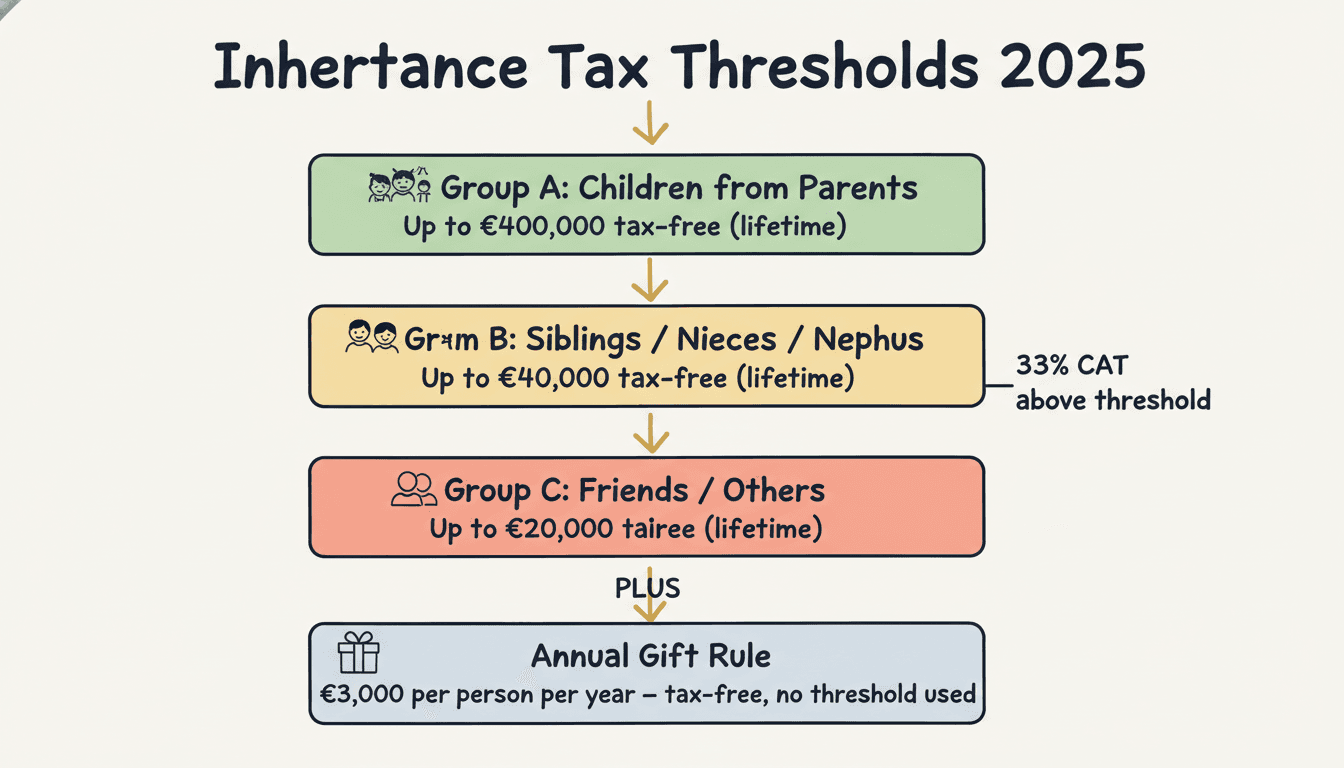
When someone leaves you money or property, Ireland's Revenue charges Capital Acquisitions Tax (CAT) if the value exceeds the tax-free threshold for your relationship group. At 33%, CAT can be a significant charge — particularly for property inheritances where values have risen sharply. This guide explains the thresholds, key exemptions, and what you need to do if you receive a taxable inheritance.
What Is Capital Acquisitions Tax?
Capital Acquisitions Tax (CAT) applies to gifts and inheritances in Ireland. Both are treated similarly — the distinction is that an inheritance arises on death, while a gift is received from a living person. The rate is 33% on the taxable value above the relevant threshold.
CAT is the responsibility of the beneficiary (the person receiving the asset), not the estate of the deceased. In practice, many estates pay the CAT on behalf of beneficiaries to simplify administration.
The Three CAT Threshold Groups
The most important factor in CAT is your relationship to the person giving the gift or leaving the inheritance. Revenue uses three groups:
| Group | Who Qualifies | 2025 Tax-Free Threshold |
|---|---|---|
| Group A | Child (including adopted/step-child), minor grandchild (certain conditions) | €400,000 |
| Group B | Sibling, parent, niece, nephew, grandchild (in most cases), grandparent | €40,000 |
| Group C | Everyone else (cousins, friends, unmarried partners, colleagues) | €20,000 |
These thresholds apply cumulatively over your lifetime. Every gift or inheritance you receive from persons in the same group is added together. Once your cumulative receipts exceed the threshold, CAT at 33% applies.
Example: If you received €200,000 from your father in 2015 and now receive €350,000 from your mother's estate in 2025, your cumulative Group A receipts are €550,000. The tax-free threshold is €400,000. CAT applies on €150,000 × 33% = €49,500.
The Small Gift Exemption: €3,000 Per Year
Any person can give any other person up to €3,000 per year completely tax-free. This is known as the Small Gift Exemption and it applies on top of the group thresholds.
Why this matters for planning: Parents can give each child €3,000 per year without it eating into the Group A threshold. If two parents each give €3,000 to a child, that's €6,000 per year with no CAT implications, and none of it counts against the €400,000 lifetime threshold.
Over 10 years, a married couple can pass €60,000 to a child through annual small gifts — entirely CAT-free.
Key Exemptions and Reliefs
Several important situations reduce or eliminate CAT:
Dwelling House Exemption If you inherit a home that was your principal private residence at the time of the inheritance, and you lived there for three years before the inheritance, the dwelling house is exempt from CAT. Conditions:
- You must continue to own and occupy the dwelling for six years after the inheritance
- You must not have had a beneficial interest in any other house at the date of the inheritance
This exemption is crucial for situations where a child has been living with an elderly parent and inherits the family home.
Agricultural Relief Qualifying farmers who inherit agricultural land and assets may have the agricultural property value reduced by 90% for CAT purposes, dramatically reducing the taxable value. The conditions are complex and require the beneficiary to be an active farmer or to lease the land to an active farmer for at least six years.
Business Relief Businesses and business assets (including shares in qualifying companies) can be reduced by 90% for CAT purposes when transferred to a beneficiary who will continue the business. Significant conditions apply.
Spouse/Civil Partner Exemption Gifts and inheritances between spouses or civil partners are completely exempt from CAT, with no limit. This is one of the most important exemptions in the entire system.
How Is the Taxable Value Calculated?
CAT is calculated on the market value of the asset on the date of the gift or inheritance, after deducting any liabilities that pass with the asset (e.g., a mortgage on an inherited property).
For property, market value is typically established by a qualified valuer. Revenue can challenge valuations it considers too low.
Example: Inheritance of a buy-to-let property
| Amount | |
|---|---|
| Market value of property | €320,000 |
| Outstanding mortgage (passing with property) | –€80,000 |
| Net taxable value | €240,000 |
| Prior Group B gifts received | €20,000 |
| Cumulative Group B benefits | €260,000 (against a €40,000 lifetime threshold) |
| Amount over Group B threshold | €220,000 |
| CAT at 33% | €72,600 |
When and How to Pay CAT
CAT must be filed and paid using Revenue's IT38 return, filed through myAccount or ROS. The deadline depends on the valuation date (broadly, the date you become entitled to the inheritance or gift): if the valuation date falls between 1 January and 31 August, you must file and pay by 31 October of that year; if it falls between 1 September and 31 December, the deadline is 31 October of the following year.
Revenue's CAT filing guidance covers the process in detail.
If you receive a large inheritance and can't pay the CAT immediately (for example, you've inherited illiquid property), Revenue does have provisions for paying in instalments in certain circumstances.
Planning Ahead: Reducing CAT
Common legitimate strategies to reduce the eventual CAT burden include:
- Annual small gifts — using the €3,000 per person per year exemption over many years
- Pension funding — pension assets pass outside the estate in many cases and are not subject to CAT (though they may be subject to income tax when drawn down by the beneficiary)
- Gifting property early — gifting assets during lifetime means the threshold is the same, but the value at the time of the gift may be lower than at death if prices rise further; however, a later sale may trigger CGT for the donor
- Section 72 insurance policies — life assurance policies specifically designed to cover a CAT liability; the payout is not subject to CAT if the policy is correctly structured
Frequently Asked Questions
Does the CAT threshold reset after each inheritance? No. The threshold is a lifetime cumulative amount within each group. All gifts and inheritances from within the same group are added together over your entire lifetime. Once the cumulative amount exceeds the threshold, every euro above it is taxed at 33%.
My parents gave me money toward a house deposit. Does that use my Group A threshold? Yes. A gift from a parent to a child falls within Group A and counts against the €400,000 threshold. However, the €3,000 annual Small Gift Exemption from each parent is excluded first. If your parents each gifted you €3,000 and then gave you €50,000 as a lump sum, the lump sum uses €50,000 of your Group A threshold.
My partner and I are not married. What is my CAT exposure if they leave me their estate? The spouse exemption only applies to legal spouses and civil partners. An unmarried partner falls into Group C — you can receive only €20,000 from them tax-free before CAT at 33% applies on the remainder. For unmarried couples with significant shared assets, this is a major planning issue. Consider marriage, a civil partnership, or a properly structured will and insurance arrangement.
I live in the UK and am inheriting Irish property. Am I still liable for Irish CAT? Yes. CAT applies where the asset is located in Ireland or where either the person who left the property or the beneficiary is Irish-domiciled. You can be fully resident abroad and still owe Irish CAT on Irish property inherited from an Irish estate.
Does CGT and CAT apply on the same inheritance? They are separate taxes triggered by different events. CAT applies to the beneficiary at the point of receiving the inheritance. CGT applies to the estate if a specific asset was disposed of between death and distribution, or it applies to the beneficiary later if they sell the inherited asset. Revenue has a credit mechanism to avoid full double taxation where the same event triggers both.
This article is for informational and estimation purposes only. It does not constitute professional tax advice. Tax rules can change. Always check Revenue.ie for the latest figures or consult a qualified tax advisor for your specific situation.
Written by a Chartered Accountant
All guides on Irish Tax Estimator are written and reviewed by a qualified Irish Chartered Accountant to ensure accuracy. This article is for general information only and does not constitute professional tax advice.
Share this guide