- Tax credits reduce your actual tax bill euro-for-euro — far more valuable than tax deductions
- Every single PAYE worker is entitled to the €2,000 Personal Credit and the €2,000 PAYE Credit automatically
- Many workers miss out on additional credits for medical expenses, remote working, and dependent relatives — you can backdate claims up to 4 years
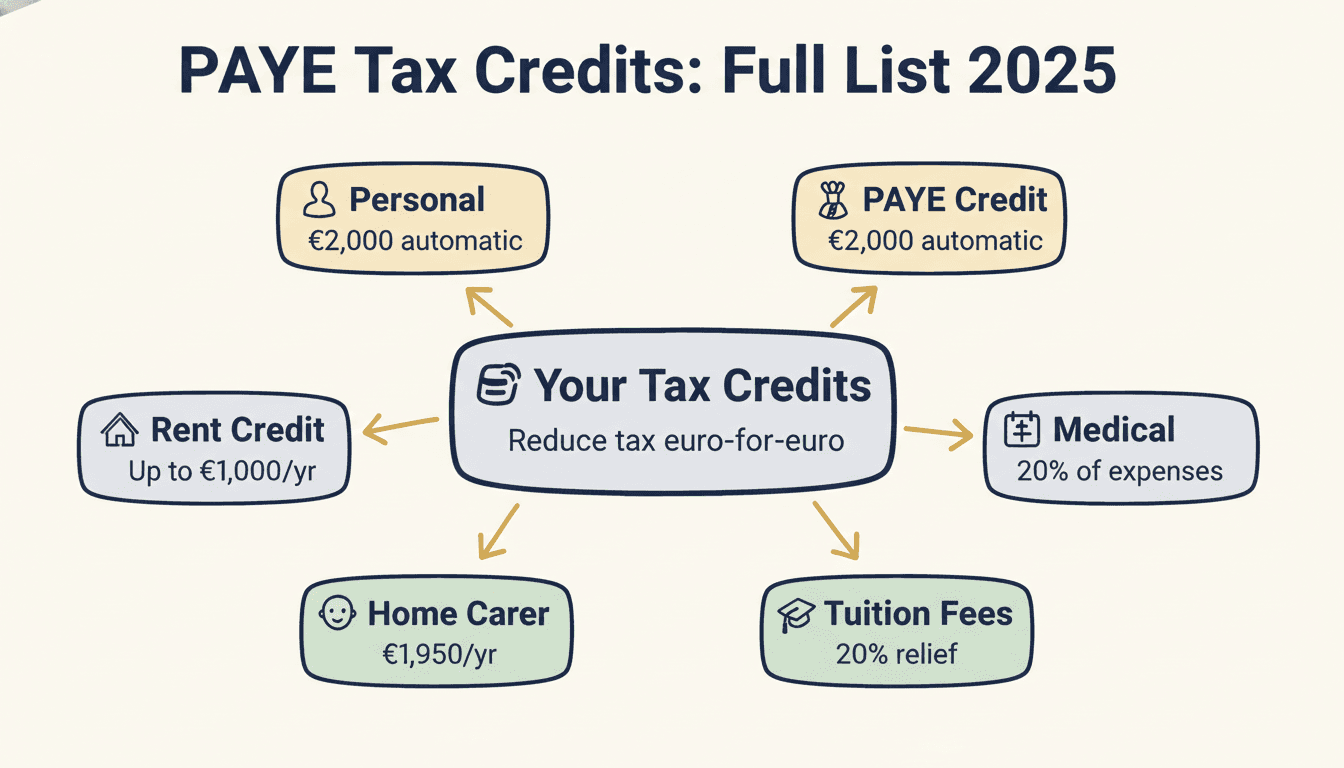
Every year, thousands of Irish PAYE workers overpay tax simply because they don't know about — or haven't claimed — tax credits they're fully entitled to. Unlike tax deductions (which reduce your income), tax credits reduce your actual tax bill euro-for-euro. That makes them extremely valuable.
Here's a complete guide to the key tax credits available to PAYE workers in Ireland for 2026.
What Is a Tax Credit?
A tax credit directly reduces the amount of income tax you owe. If your tax bill before credits is €5,000 and you have €4,000 in credits, you only pay €1,000.
Credits are different from tax reliefs or deductions, which just reduce your taxable income.
Credits You Get Automatically
1. Personal Tax Credit — €2,000
Every individual taxpayer in Ireland receives this credit automatically. Married couples or civil partners receive €4,000 (doubled). You don't need to claim it — Revenue applies it to all taxpayers.
2. PAYE Tax Credit — €2,000
If you're a PAYE employee, you receive an additional €2,000 tax credit. This is applied automatically through your employer's payroll. Self-employed individuals receive the Earned Income Credit instead (see below).
Together, these two credits mean you pay zero income tax on your first €20,000 of income as a single PAYE employee.
Credits You May Need to Claim
3. Rent Tax Credit — Up to €1,000 per person
If you're renting privately in Ireland, you can claim a Rent Tax Credit of up to €1,000 per year (€2,000 for a couple) for 2025 and 2026. The credit was introduced in Budget 2023 and has been maintained at €1,000 for 2026. For prior years it was lower: €500 for 2022 and 2023, €1,000 for 2024 onwards.
How to claim: Log in to myAccount on Revenue.ie and submit your claim through the PAYE services section.
4. Home Carer Tax Credit — €1,950
Available to married couples where one spouse stays at home to care for a dependent person (a child, elderly parent, or person with a disability). The full credit applies where the carer earns €7,200 or less; it tapers to nil at €11,100.
This credit is worth up to €1,950 and is frequently unclaimed by eligible families.
How to claim: Via myAccount or your annual tax return. See the full guide: Home Carer Tax Credit Ireland 2026.
5. Incapacitated Child Tax Credit — €3,800
If you have a child who is permanently incapacitated either physically or mentally, you may be entitled to this credit. The incapacity must have arisen before the child turned 21, or while they were still in full-time education or training.
6. Age Tax Credit — €245 (single) / €490 (married)
If you or your spouse are aged 65 or over, you receive an additional tax credit of €245 (single) or €490 (married). This is automatically applied once Revenue is aware of your date of birth.
7. Dependent Relative Tax Credit — €305
If you maintain a relative (or someone you treat as a relative) who is incapacitated or aged 65+, and their income is below a certain threshold, you may claim this credit.
8. Medical Expenses Relief — 20% of eligible expenses
You can claim tax relief at 20% on medical expenses not covered by health insurance or a compensation scheme. This includes:
- Doctor and hospital visits
- Dental treatment (routine is excluded; surgical/specialist is allowed)
- Prescriptions
- Physiotherapy, speech therapy, occupational therapy
How to claim: Via myAccount for the previous 4 years.
9. Tuition Fees Relief
If you pay tuition fees for an approved full-time or part-time undergraduate or postgraduate course, you can claim relief at 20% on qualifying fees of up to €7,000 per course per year, after a disregarded amount (the first €3,000 for full-time courses, €1,500 for part-time in 2026).
10. Employee Pension Contributions (AVCs)
Additional Voluntary Contributions (AVCs) to a pension scheme qualify for tax relief at your marginal rate (20% or 40%). This is one of the most powerful ways to reduce your tax bill — contributing to a pension effectively costs you far less than the contribution amount.
How to Review What You're Claiming
- Log in to myAccount on Revenue.ie
- Go to PAYE Services → Manage Your Tax 2026
- Check your Tax Credit Certificate to see what credits are currently applied
- Submit any claims for relief (medical expenses, rent credit, etc.) through the Claim a Tax Credit section
You can also claim credits for the previous 4 years — so if you've been missing the Rent Tax Credit, you can reclaim it for 2022, 2023, 2024, and 2025.
The Bottom Line
The Irish tax system offers a range of credits designed to recognise different life circumstances. The problem is that Revenue doesn't always know your situation — you have to tell them.
Setting aside 30 minutes to review your tax credits on myAccount could easily result in a refund of hundreds or even thousands of euros.
Use the Irish Tax Estimator calculator to see how different tax credits affect your take-home pay. Not sure if you have overpaid tax? Use our free PAYE Tax Refund Calculator to get an instant estimate of what Revenue may owe you.
This article is for general information only and does not constitute professional tax advice. Figures are based on Revenue.ie guidelines for tax year 2026. Consult a qualified tax advisor for advice specific to your situation.
Written by a Chartered Accountant
All guides on Irish Tax Estimator are written and reviewed by a qualified Irish Chartered Accountant to ensure accuracy. This article is for general information only and does not constitute professional tax advice.
Share this guide