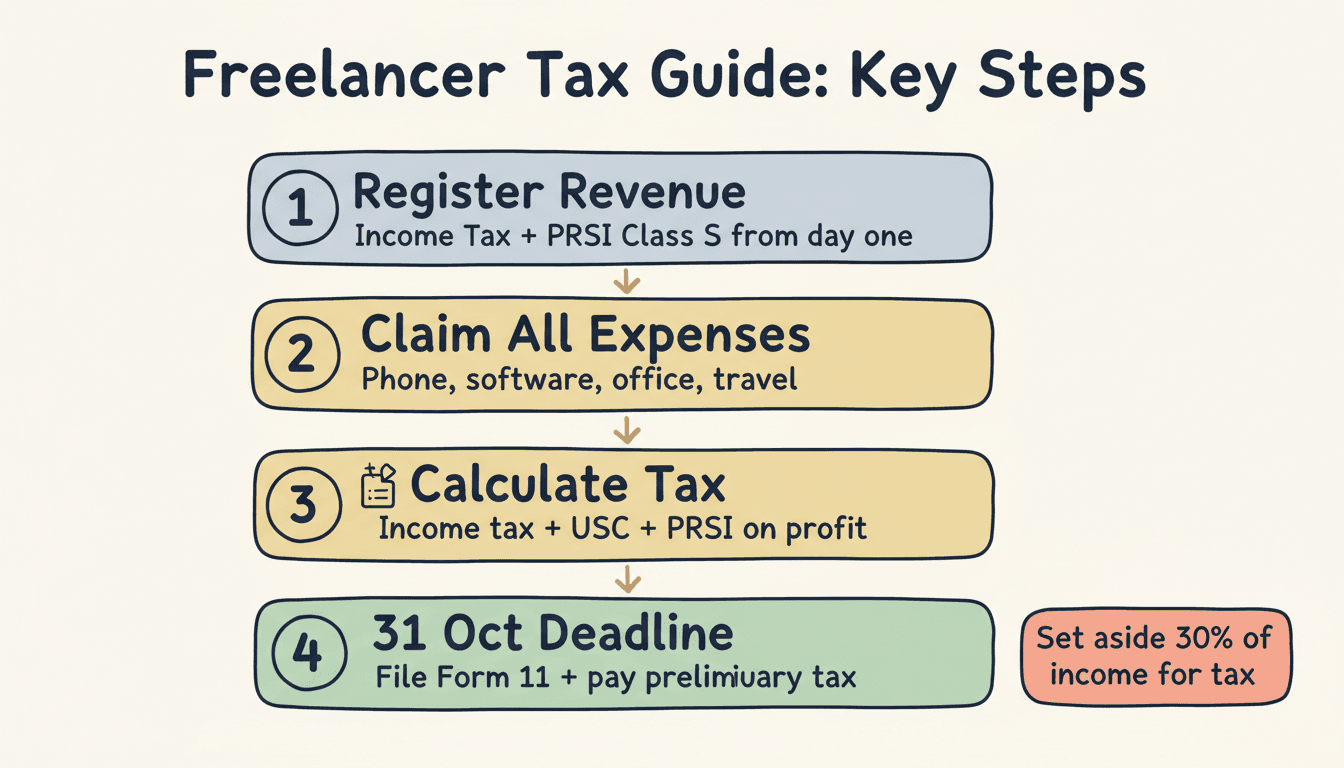
- Register with Revenue immediately when you go self-employed — you'll need to sign up for Income Tax (self-assessed) and PRSI Class S
- The key annual deadline is 31 October: file your Form 11 and pay your preliminary tax for the current year at the same time
- You can deduct legitimate business expenses (phone, software, home office) before calculating your taxable profit
Going self-employed in Ireland is exciting, but the shift from PAYE to self-assessment can feel daunting. Unlike a PAYE job where tax is deducted automatically, self-employed individuals are responsible for calculating and paying their own tax.
This guide covers everything you need to know as a freelancer or sole trader in Ireland in 2025.
Step 1: Register with Revenue
As soon as you start trading on a self-employed basis, you must register with Revenue. You'll need to register for:
- Income Tax (self-assessed)
- PRSI Class S (self-employed PRSI)
If your turnover exceeds or is likely to exceed €42,500 (services) or €85,000 (goods) — the thresholds in force since 1 January 2025 — you also need to register for VAT.
How to register: Log in to Revenue's myAccount and use the eRegistration service to register as self-employed.
How Self-Employed Tax Works: Self-Assessment
Under self-assessment, you file an annual Form 11 (Income Tax Return) by 31 October each year, declaring all income earned in the previous tax year.
For example:
- 31 October 2025 — file your 2024 tax return and pay any balance of tax owed
Preliminary Tax — The Payment You Must Make in Advance
This catches many new self-employed people off guard. You must pay preliminary tax by 31 October for the current tax year — at the same time as you file your return for the previous year.
Preliminary tax must be the higher of:
- 90% of your final liability for the current year, OR
- 100% of your liability from the previous year (the "safe harbour" rule)
Most people use the 100% of prior year method to avoid any risk of under-paying.
Example: If you owed €5,000 tax for 2024, you'd pay €5,000 as preliminary tax for 2025 by 31 October 2025.
What Tax Do Self-Employed People Pay?
The same three charges apply as for PAYE workers, but with key differences:
Income Tax
The rates are identical (20% and 40%), but self-employed people do not get the PAYE Tax Credit of €2,000. Instead, you get the Earned Income Tax Credit of €2,000 — the same amount.
The personal tax credit (€2,000 single / €4,000 married) still applies.
USC
USC applies at the same rates as PAYE workers. However, if your self-employment income exceeds €100,000, you pay an additional 3% USC surcharge on the excess.
PRSI — Class S
Self-employed individuals pay Class S PRSI at 4.1% of their gross income in 2025 (rising to 4.2% from 1 October 2025 under the multi-year PRSI roadmap), with a minimum annual payment of €650. Unlike PAYE (Class A), Class S does not entitle you to Jobseeker's Benefit — but it does qualify you for State Pension (Contributory) and other benefits.
Claiming Business Expenses
One of the biggest advantages of self-employment is the ability to deduct legitimate business expenses against your income. This reduces your taxable profit and therefore your tax bill.
Allowable expenses typically include:
| Expense | Notes |
|---|---|
| Home office | Proportion of heating, electricity, broadband based on space and usage |
| Equipment | Laptops, phones, cameras — capital allowances apply |
| Professional fees | Accountant, solicitor costs |
| Insurance | Professional indemnity, public liability |
| Travel | Mileage at Revenue rates, flights, accommodation (business only) |
| Training & courses | Directly relevant to your work |
| Software & subscriptions | Tools used in your business |
| Marketing | Website, advertising |
| Bank charges | Business account fees |
Important: Only expenses that are "wholly and exclusively" for business purposes are allowable. Personal expenses cannot be claimed.
Capital Allowances
Large purchases like machinery, equipment and vehicles are not deducted as expenses in full in the year of purchase. Instead, you claim capital allowances at 12.5% per year over 8 years (for most business assets).
VAT — When and How
If your annual turnover exceeds:
- €42,500 for services, or
- €85,000 for goods
You must register for VAT. You collect VAT from clients and pay it to Revenue (usually bi-monthly).
Even below these thresholds, you can register voluntarily if it benefits you (e.g. if you have high VAT-able inputs).
Key Deadlines for Self-Employed
| Date | Obligation |
|---|---|
| 31 October (each year) | File previous year's Form 11 income tax return |
| 31 October (each year) | Pay balance of tax for previous year |
| 31 October (each year) | Pay preliminary tax for current year |
| Mid-November (each year) | Extended deadline if you both file and pay through ROS |
| Bi-monthly | VAT returns (if registered) |
Getting Set Up: Practical Tips
- Open a separate business bank account — makes it far easier to track income and expenses
- Keep all receipts — digital or paper, store everything for 6 years
- Set aside 30% of income for tax — a rough but safe rule for most freelancers
- Use accounting software — tools like Surf Accounts, Sage, or even a spreadsheet help you track P&L and prepare for Revenue
- Consider an accountant — the cost is tax-deductible, and they typically save you more than they charge
Worked Example: Freelancer Earning €60,000
Expenses deducted: €5,000 → Taxable profit: €55,000
| Income Tax (20% on €44k, 40% on €11k) | €13,200 |
| Less: Personal Credit + Earned Income Credit | –€4,000 |
| Net Income Tax | €9,200 |
| USC (0.5% / 2% / 3% bands, 2025) | €1,196 |
| PRSI (Class S, blended 4.125% for 2025) | €2,269 |
| Total Tax | €12,665 |
| Net income after tax (on €55,000 profit) | €42,335 |
Use the Irish Tax Estimator calculator to model your own scenario.
Summary
Going self-employed doesn't have to be stressful once you understand the system. The key points:
- Register with Revenue from day one
- File your Form 11 and pay your taxes by 31 October each year
- Pay preliminary tax for the current year at the same time
- Claim all legitimate business expenses to reduce your taxable income
- Set money aside consistently — don't spend it before October
This article is for general information only and does not constitute professional tax advice. Figures are based on Revenue.ie guidelines for tax year 2025. Consult a qualified tax advisor for advice specific to your situation.
Written by a Chartered Accountant
All guides on Irish Tax Estimator are written and reviewed by a qualified Irish Chartered Accountant to ensure accuracy. This article is for general information only and does not constitute professional tax advice.
Share this guide