- You can claim 20% income tax relief on qualifying medical expenses — if you spent €1,000 on qualifying costs, you get €200 back
- The claim can cover expenses for yourself, your spouse, and any dependants — and you can backdate four years
- Routine dental and optical costs are excluded, but surgery, orthodontics, and many specialist costs qualify
Medical bills in Ireland are expensive, but Revenue softens the blow with a 20% income tax relief on a wide range of qualifying medical expenses. This is one of the most straightforward tax reliefs available — no employer involvement, no complicated calculations — just a claim through myAccount based on your receipts. Yet a huge number of Irish workers never claim it.
What Is the Medical Expenses Tax Relief?
Under Section 469 of the Taxes Consolidation Act 1997, Revenue gives a 20% income tax credit on qualifying health expenses paid by you in the year. The relief is given at the standard rate (20%) regardless of whether you're a higher-rate taxpayer — with one important exception: nursing home fees qualify for relief at your highest rate of tax (up to 40%).
This means:
- Spent €500 on qualifying medical costs → you get €100 back
- Spent €2,000 → you get €400 back
- Spent €5,000 → you get €1,000 back
There is no minimum threshold — even small claims are worthwhile. You can claim for yourself, your spouse or civil partner, your children, or any other individual who was a dependant at the time of the expense.
What Medical Expenses Qualify?
Revenue maintains a detailed list of qualifying expenses. The main categories that qualify include:
Doctors and specialists:
- GP visits
- Consultant fees (cardiologist, neurologist, psychiatrist, etc.)
- Non-routine dental treatment (extractions, fillings, crowns, root canal — but NOT check-ups, cleaning, or scaling)
- Orthodontic treatment (braces)
- Physiotherapy and occupational therapy
- Speech and language therapy
- Psychotherapy and counselling
- Fertility treatments (IVF)
- Nursing home care (relieved at your marginal rate, up to 40% — the only health expense not limited to the 20% standard rate)
Hospitals and procedures:
- Hospital treatment (private or public)
- Surgical procedures
- Diagnostic tests ordered by a doctor (MRI, blood tests, scans)
- Prescribed drugs and medicines
Other qualifying items:
- Hearing aids
- Orthoptic treatment (eye muscle exercises)
- Gluten-free food prescribed for coeliac disease (requires a medical letter)
- Educational tools for children with learning difficulties if prescribed
- Transport to and from medical care (in certain circumstances)
What Does NOT Qualify?
This is where many people make mistakes. The following are specifically excluded:
- Routine dental check-ups, cleaning, and descaling
- Routine eye tests and optician fees
- Cosmetic surgery (unless required for medical reasons)
- Gym membership (even if recommended by a doctor)
- Over-the-counter medications (aspirin, paracetamol, vitamins)
- Private health insurance premiums (these have their own separate relief — see below)
- Travel costs to the chemist or GP for routine visits
The distinction Revenue draws is between treatment that corrects or addresses a medical condition versus maintenance or general wellbeing. Orthodontics qualifies; a routine scale and polish does not.
Health Insurance: Separate Relief
Private health insurance premiums are not claimed as medical expenses. Instead, Revenue gives a 20% tax credit at source — meaning the insurance company already deducts the credit before charging you your premium. Your VHI, Laya, or Irish Life Health invoice shows the "net" (after-credit) premium. You don't need to do anything further for the insurance itself.
However, any excess you pay out of pocket after insurance reimbursement on qualifying treatments can be claimed through the medical expenses relief. If your insurance covers 80% of a consultant fee, the remaining 20% can be claimed.
How to Claim: Step by Step
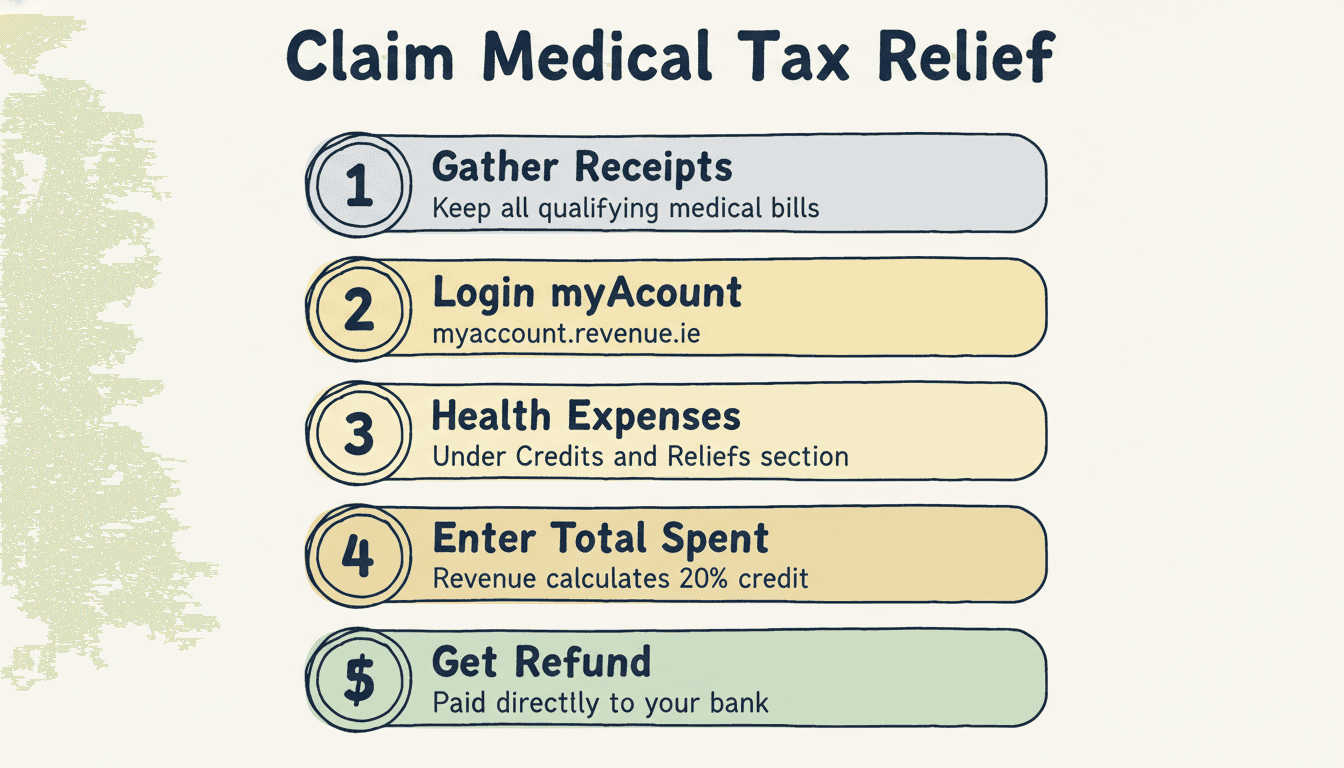
Step 1: Gather your receipts Keep all receipts for qualifying medical expenses during the year. You don't submit them with your claim — Revenue may request them if they conduct a check.
Step 2: Sign in to Revenue myAccount Go to myaccount.revenue.ie.
Step 3: Select "Review Your Tax" Choose the tax year. You can claim for the current year and up to four prior years.
Step 4: Enter your medical expenses Under "Credits and Reliefs," select "Health Expenses." Enter the total qualifying amount you spent. Revenue calculates the 20% credit.
Step 5: Submit and receive your refund Any tax refund is paid directly to your bank account.
Revenue's health expenses guidance has the definitive list of qualifying expenses.
Backdating Claims
You can claim medical expenses for the four prior tax years. If you're claiming in 2026, you can go back to 2022. This can add up significantly — if you've been spending €1,500/year on qualifying medical costs and never claimed, that's potentially €1,200 in refunds sitting unclaimed.
Worked Example: The Murphy Family, 2026
| Family Member | Expense | Qualifying? | Amount |
|---|---|---|---|
| Parent | GP visits (4 visits × €65) | Yes | €260 |
| Parent | Consultant (cardiologist) | Yes | €250 |
| Parent | Physiotherapy (10 sessions) | Yes | €600 |
| Parent | Routine dental check-up | No | — |
| Child | Orthodontics (braces, instalment) | Yes | €1,500 |
| Child | Speech therapy (8 sessions) | Yes | €480 |
| Child | School optician visit (routine) | No | — |
| Total qualifying expenses | €3,090 | ||
| Tax relief at 20% | €618 |
The Murphy family gets €618 back from Revenue — money they're fully entitled to and left unclaimed in prior years.
Frequently Asked Questions
Can I claim medical expenses my health insurance already covered? No. You can only claim the portion of expenses you actually paid yourself, after any insurance reimbursement. Claiming on costs you didn't personally bear would be incorrect.
Do I need original receipts or do scanned copies work? Revenue accepts scanned receipts. However, you should retain the originals for at least six years in case of an audit. If you use a medical app like Doctorcare or VHI's member portal, statements from these may be accepted as supporting evidence.
Can I claim my child's medical expenses even though they're covered under my health insurance? Yes, for costs you personally paid that your insurance didn't cover. Children's qualifying medical costs claimed by a parent are a very common and legitimate claim.
What about nursing home costs for a parent? Yes — and this is the most valuable health expense relief of all. Nursing home fees (where the home provides 24-hour nursing care on-site) qualify for relief at your highest rate of income tax, up to 40% — not the standard 20% that applies to other medical expenses. They can be claimed by the person paying the fees — either the parent themselves or a child paying on their behalf. Given nursing home costs can be €40,000+ per year, relief at 40% can be worth €16,000+ annually.
Can my employer pay my medical expenses tax-free? Some employers have medical expense schemes (often called "salary sacrifice" or "flexible benefit" arrangements) that allow you to pay for qualifying costs from pre-tax income. If your employer offers this, it's typically more efficient than claiming through Revenue after the fact. Check with HR.
This article is for informational and estimation purposes only. It does not constitute professional tax advice. Tax rules can change. Always check Revenue.ie for the latest figures or consult a qualified tax advisor for your specific situation.
Written by a Chartered Accountant
All guides on Irish Tax Estimator are written and reviewed by a qualified Irish Chartered Accountant to ensure accuracy. This article is for general information only and does not constitute professional tax advice.
Share this guide