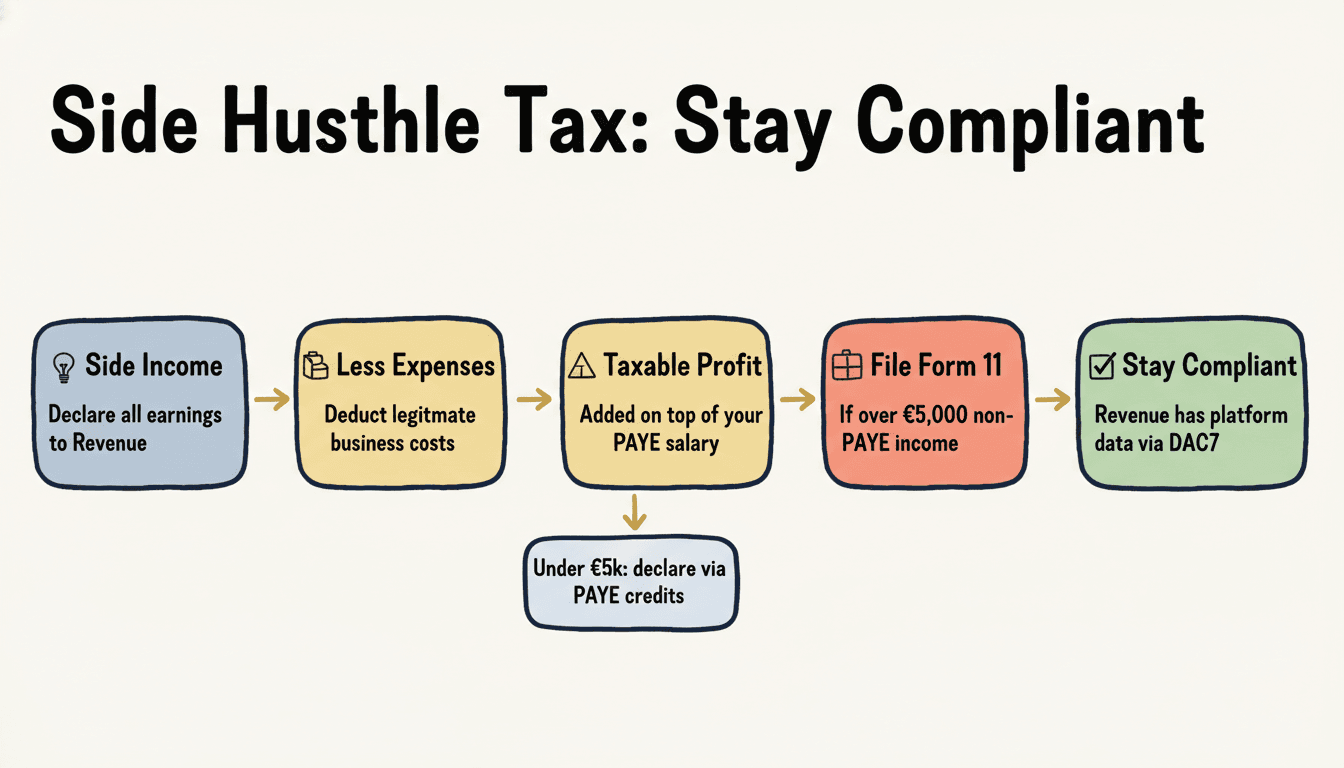
- Any income from a side hustle — Airbnb, freelancing, selling online, tutoring — must be declared to Revenue
- If your non-PAYE income exceeds €5,000 per year, you must register as self-assessed and file a Form 11
- You can deduct legitimate business expenses before calculating the tax you owe, which can significantly reduce your bill
The gig economy has exploded in Ireland. Whether you're renting a room on Airbnb, doing graphic design on the side, driving for a delivery platform, selling handmade goods on Etsy, or tutoring students after work, you're generating income that Revenue wants to know about. This guide explains the rules clearly, covers what you can deduct, and shows you how to stay compliant without paying more tax than you need to.
Does Revenue Know About Your Side Income?
Yes, increasingly so. Revenue has data-sharing agreements with many digital platforms. Airbnb, eBay, and other marketplaces are required under EU law (DAC7 regulations, which came into force in Ireland in 2023) to report seller and host income directly to Revenue. Revenue's data analytics unit also cross-references bank deposits, social media, and Companies Registration Office filings.
The era of "Revenue won't find out" is over. The smarter approach is simple compliance — declare your income, deduct your allowable expenses, and pay the correct amount of tax.
The €5,000 Threshold: When You Must Register
If your non-PAYE income from a side hustle is less than €5,000 per year, and you are already a PAYE worker, you can declare this income by contacting Revenue directly and having it collected through your PAYE tax credits. You don't necessarily need to file a full self-assessed return.
If your non-PAYE income exceeds €5,000 per year, you must register for self-assessment and file a Form 11 each year. The Form 11 is the self-assessed income tax return, due by 31 October each year (or mid-November if you file online through ROS).
Don't wait until you're over the threshold to register. Revenue expects proactive registration. If you're earning a consistent side income, register early.
What Counts as Taxable Side Income?
Almost everything. Here is a non-exhaustive list:
- Freelance / consulting income — design, writing, IT, legal, marketing, etc.
- Airbnb income — renting your home or a room (separate rules apply for the Rent-a-Room Relief scheme — see below)
- Gig platforms — Deliveroo, Uber Eats, Amazon Flex, TaskRabbit
- Selling online — Etsy, eBay, Facebook Marketplace (for goods you made or bought to sell, not one-off personal items)
- Tutoring / coaching / music lessons
- Content creation — YouTube ad revenue, Substack subscriptions, OnlyFans, influencer fees
- Cryptocurrency gains — buying and selling crypto is treated as a Capital Gains Tax event
- Dividend income from shares (Irish withholding tax applies but you may owe more)
What Can You Deduct?
You only pay income tax on your profit, not your gross income. Revenue allows you to deduct legitimate business expenses before calculating tax. Common deductible expenses for side hustlers include:
| Expense Category | Examples |
|---|---|
| Materials and stock | Craft supplies, goods you buy to resell |
| Equipment | Laptop, camera, microphone (pro-rated if also personal use) |
| Subscriptions and software | Adobe Creative Cloud, Canva Pro, accounting software |
| Home office costs | Proportion of electricity and broadband (same 30% rule as remote work relief) |
| Transport | Business share of actual motor costs — fuel, insurance, servicing, apportioned between business and personal use. (The civil-service per-km mileage rates are for employees only; the self-employed claim actual costs) |
| Marketing | Website hosting, paid advertising, business cards |
| Professional fees | Accountant, bookkeeper, legal fees |
| Phone | Business proportion of your mobile bill |
You cannot deduct personal expenses, fines, or costs that are not wholly and exclusively for the trade. Keep receipts and bank statements for everything — Revenue can audit up to four years back.
How Is Side Income Taxed?
Side hustle profit is added to your total income for the year and taxed at your marginal rate. For most people with a PAYE job as well, side income falls on top of PAYE income and is taxed at the 40% marginal rate once your combined income exceeds €44,000.
Additionally, you'll owe:
- USC on the gross side income (at your applicable USC rate)
- PRSI — self-employed PRSI is Class S, charged at 4.1% in 2025 (rising to 4.2% from 1 October 2025), with a minimum annual payment of €650
Worked Example: Siobhán, PAYE worker (€48,000 salary), plus Airbnb income
| Amount | |
|---|---|
| Airbnb gross income | €9,000 |
| Less allowable expenses | –€1,200 |
| Taxable profit | €7,800 |
| Income tax (at 40% marginal rate) | €3,120 |
| USC (at 3%) | €234 |
| PRSI Class S (minimum charge — 4.125% × €7,800 is below the €650 floor) | €650 |
| Total additional tax | €4,004 |
| Net income from Airbnb after expenses and tax | €3,796 |
Use the Irish Tax Estimator income tax calculator to model your combined PAYE + side income position.
Rent-a-Room Relief: Up to €14,000 Tax-Free
If you rent a room in the home you live in — not a separate Airbnb property, but a room in your primary residence while you live there — you may qualify for the Rent-a-Room Relief. This exempts rental income up to €14,000 per year from income tax, USC, and PRSI entirely.
This applies to residential lettings — a lodger, a student in digs, or anyone using the room as their home. It does not apply to short-term guest stays such as Airbnb: Revenue treats income from guest accommodation as trading income, which is excluded from Rent-a-Room Relief regardless of the amount. If your qualifying rental income from the room exceeds €14,000, the entire amount becomes taxable — not just the excess.
Revenue's Rent-a-Room guidance covers the conditions in detail.
Key Dates for Self-Assessed Taxpayers
| Date | Obligation |
|---|---|
| 31 October | Form 11 filing deadline (paper) |
| Mid-November | Extended deadline if filing and paying via ROS |
| 31 October | Preliminary tax payment for current year (90% of final liability) |
| 31 March | P30 / PSWT returns if applicable |
Missing these deadlines results in surcharges and interest. The surcharge for late filing is 5% of the additional tax due (up to €12,695) if filed within two months, and 10% (up to €63,485) if filed more than two months late.
How to Register for Self-Assessment
- Go to Revenue.ie → myAccount → "Register for a Tax"
- Select "Income Tax – Self-Assessment"
- Revenue will issue you a ROS Digital Certificate if you need to file through ROS (the Revenue Online Service, used for Form 11)
- File your first Form 11 by the October deadline for the first tax year in which you had over €5,000 in non-PAYE income
If this is your first time doing self-assessment, an accountant for the first year can be worthwhile to make sure you claim all allowable expenses correctly. The fee is itself deductible.
Frequently Asked Questions
I only made €2,000 from my side hustle. Do I still need to tell Revenue? Yes, you should declare it. For amounts under €5,000 you can request Revenue to code it against your PAYE tax credits rather than filing a full Form 11. But you must still declare it — failing to do so is tax evasion, even on small amounts.
Do I need to register a business name or form a company? No. Most side hustles operate as a sole trader, which requires no company registration. You simply register for self-assessment with Revenue and operate under your own name. A company (limited company) is only worth considering when profits become significant, usually above €50,000–€80,000 net profit.
Can I offset my side hustle losses against my PAYE income? Generally, yes — losses from a trade can be offset against other income, including PAYE salary. However, Revenue has rules against using losses from a "hobby" trade (one without a genuine profit motive) to shelter other income. Keep records showing you're running a genuine commercial business.
I've been selling on eBay for a few years without declaring it. What should I do? Voluntarily disclose your income to Revenue before they come to you. Unprompted disclosures receive significantly lower penalties than those arising from a Revenue investigation. Revenue's voluntary disclosure scheme explains the process. An accountant can help structure this.
Do gig platform workers (Deliveroo, Uber Eats) get a self-employed tax bill or a PAYE one? Gig workers on these platforms are classified as self-employed by the platforms (though this classification is legally contested). Revenue treats them as self-employed for tax purposes. You must register for self-assessment, file a Form 11, and pay income tax, USC, and Class S PRSI on your net earnings.
This article is for informational and estimation purposes only. It does not constitute professional tax advice. Tax rules can change. Always check Revenue.ie for the latest figures or consult a qualified tax advisor for your specific situation.
Written by a Chartered Accountant
All guides on Irish Tax Estimator are written and reviewed by a qualified Irish Chartered Accountant to ensure accuracy. This article is for general information only and does not constitute professional tax advice.
Share this guide