- Revenue now pays all tax refunds directly to YOUR own bank account — no exceptions
- The A2 process (where agents like Taxback.com collected refunds on your behalf) was fully removed in January 2026
- If your bank details are not registered in myAccount, your refund will not process
- You can still use a tax agent — but they must charge fees separately, not deduct from your refund
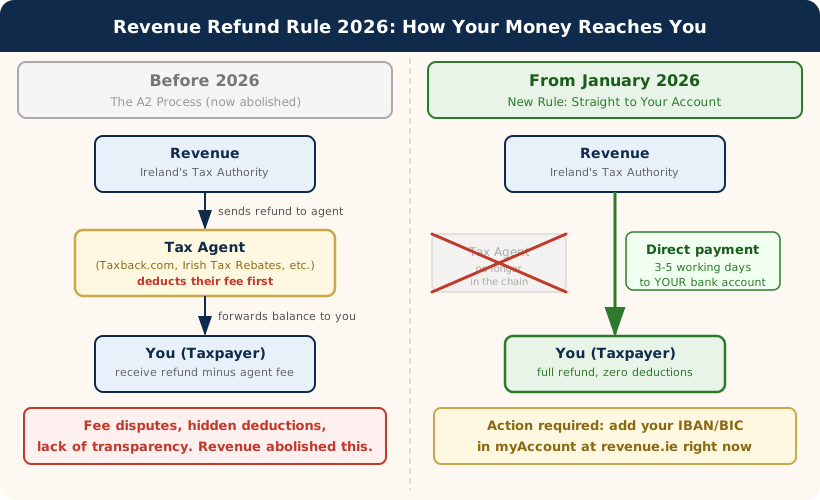
If you have ever used a service like Taxback.com or Irish Tax Rebates to claim money back from Revenue, the rules have changed significantly. Under Revenue's new 2026 refund rule, all tax refunds must go directly to your own bank account — not your agent's. Every PAYE taxpayer in Ireland is affected. Some may not even know their refund is waiting and not being paid out because their bank details are missing.
This post covers exactly what changed, why it happened, and the specific steps you need to take to make sure your money reaches you.
What Is Revenue's New Refund Rule for 2026?
From January 2026, Revenue pays all PAYE tax refunds directly and exclusively to the taxpayer's own bank account on file in myAccount. The long-standing "A2 process" — which allowed you to authorise a tax agent to receive your refund — has been fully abolished. If your bank details are not registered in myAccount, Revenue cannot issue your refund.
This change applies to every PAYE worker in Ireland. It does not matter whether you use a tax agent, file on your own, or have a long-standing arrangement with a refund service. The refund goes to you and only you.
Here is how the rule rolled out:
| Phase | Date | What Happened |
|---|---|---|
| New client cutoff | 1 January 2025 | New A2 authorisations stopped being accepted |
| Existing client cutoff | 31 December 2025 | All existing agent bank account details removed from Revenue records |
| Full implementation | 1 January 2026 | A2 process completely withdrawn for all taxpayers |
According to Revenue.ie, once a refund is approved, it is "transferred directly to the bank account details on your Revenue record within three to five working days."
What Was the A2 Process?
Before 2026, taxpayers could sign an "Authorisation Form PAYE A2." This let a tax agent provide their own bank account details to Revenue. When your refund was approved, Revenue sent the money to your agent. The agent deducted their fee and forwarded the remaining balance to you.
It was a common arrangement. Services like Taxback.com, Irish Tax Rebates, and MyTaxRebate.ie built entire business models around it. For many workers, it was convenient — they signed once and let the agent handle everything.
But the arrangement also caused problems. Some taxpayers did not fully understand what fees were being deducted. Others disputed the amount they received. Revenue took the view that directing public money anywhere other than the taxpayer's own account created unnecessary risk and a lack of transparency.
As reported by Irish Tax Hub, Revenue began phasing out the A2 process in 2025, with the full removal taking effect in January 2026. Agents now have no access to the refund payment at all.
Which Tax Refund Services Are Affected?
All PAYE tax refund agents are affected by this change, including Taxback.com, Irish Tax Rebates, and MyTaxRebate.ie. These services can still help you prepare your tax return and communicate with Revenue — they just cannot receive the refund payment on your behalf anymore.
The impact on how these services operate is significant:
- Before 2026: Agent receives refund, deducts fee, sends you the balance
- From 2026: Refund goes straight to your bank account. Agent sends you a separate invoice for their fee
As Irish Tax Rebates confirmed, "All agent bank account details will be removed from customer records, and from that point on, no refunds will be sent to agents, even for long-standing clients."
If you still want to use a tax agent to prepare and submit your claim, you absolutely can. The service they provide has not changed — only how and when they collect their fee. You will receive the full refund first, then pay the agent's invoice separately.
For most PAYE workers with straightforward tax situations, this is actually an opportunity to do it yourself for free. More on that below.
How Do I Update My Bank Details in Revenue myAccount?
Log into myAccount at revenue.ie, go to My Profile, then My Details, and click Edit under Bank Details. Enter your IBAN and BIC, save, and confirm with your password. The change takes effect immediately and Revenue can then issue any refund due to you.
Here are the exact steps:
- Go to myAccount on Revenue.ie and sign in
- Click My Profile in the top navigation
- Select My Details from the dropdown menu
- Scroll to the Bank Details section and click Edit
- Enter your bank details: financial institution name, account holder name, IBAN (22 characters), and BIC
- Click Save changes, enter your password, and click Submit
Your account must be SEPA-compliant, which means any standard Irish or EU bank account will qualify. Building society accounts and credit union accounts are also accepted in most cases.
One important note: if you have ever used a refund service and signed an A2 form, your bank details on Revenue's records may still show the agent's bank account (until it was removed by the December 2025 deadline). It is worth logging into myAccount and confirming your own bank details are in place before you file any claim.
For a step-by-step guide on how to review and update your details, see Revenue's official guidance on changing bank details.
How Much Could Your Tax Refund Be Worth?
Many PAYE workers are owed money and do not know it. Common reasons for an overpayment include unclaimed medical expenses, remote working tax relief, rent credits, or simply being on the wrong tax credit allocation for part of a year. Under the four-year rule, you can claim refunds going back to 2022, 2023, 2024, and 2025 right now.
Worked Example: Ciara earns €45,000 as a PAYE employee (single, 2025)
Ciara did not claim her remote working relief or her GP visit costs for 2024. Here is what she could be owed:
| Relief | Qualifying Spend | Tax Rate | Refund |
|---|---|---|---|
| Remote working (30% of broadband) | €480 per year | 40% | €192 |
| Medical expenses (GP visits) | €320 per year | 20% | €64 |
| Total potential refund | €256 |
That is €256 back for about 15 minutes of work on myAccount. Multiply that by four unclaimed years and Ciara could be owed over €1,000.
Use our PAYE Tax Refund Calculator to instantly estimate how much Revenue may owe you before you even log in to myAccount — then head in to claim it.
Do I Still Need a Tax Agent to Claim a Refund?
No. Most PAYE workers can claim a tax refund themselves for free through Revenue's myAccount service. A tax agent can still be useful if your tax situation is complex — for example, if you have rental income, foreign income, or significant self-employed earnings alongside your PAYE job. But for standard refunds, the DIY route is straightforward and costs nothing.
Here is how to claim a refund yourself through myAccount:
- Sign into myAccount at revenue.ie
- Go to PAYE Services and select Review your tax
- Select the tax year you want to review
- Add any reliefs you have not yet claimed (medical, remote working, rent credit, etc.)
- Submit — Revenue will calculate the refund and issue it to your registered bank account within 3-5 working days
As Citizens Information explains, you can review and claim for any of the past four years through this process. No accountant required.
If you do use an agent, remember that their fee is now a separate transaction. Make sure you agree on the fee in writing before they start work, so there are no surprises once your refund lands.
Our Chartered Accountant recommends that anyone with a straightforward PAYE income reviews their own tax each January. Most people find unclaimed relief within minutes.
Key Takeaways
Revenue's 2026 refund rule is actually good news for taxpayers. You now receive your full refund without any deductions, and the process is more transparent than before. But it only works if your bank details are correctly registered.
Here is your action list:
- Log into myAccount today and confirm your own IBAN and BIC are registered under Bank Details
- Review your tax for 2022, 2023, 2024, and 2025 and claim any unclaimed reliefs
- If you use a tax agent, agree their fee upfront — it will come as a separate invoice after your refund is paid
Use our free Irish tax calculator to estimate your take-home pay and get a clearer picture of your overall tax position. Then log into myAccount and claim what you are owed.
Frequently Asked Questions
When did Revenue stop sending refunds to tax agents? Revenue stopped accepting new A2 authorisations (the forms that allowed agents to receive refunds) on 1 January 2025. All existing agent bank account details were removed from Revenue records by 31 December 2025. From 1 January 2026, no refunds are sent to agents under any circumstances. The change is fully in effect now.
What happens if I do not have bank details registered in myAccount? If Revenue cannot find a valid bank account on your record, your refund will not be issued. It will not be lost, but it will sit unclaimed until you add your bank details to myAccount. Log in at revenue.ie, go to My Profile, My Details, and add your IBAN and BIC under Bank Details.
Can I still use Taxback.com or Irish Tax Rebates after the 2026 rule change? Yes. These services can still prepare your tax claim, identify what reliefs you are entitled to, and communicate with Revenue on your behalf. The only change is that they no longer receive the refund payment. Your refund will go directly to your own bank account, and you will pay the agent's fee separately by invoice.
How long does it take to get a tax refund from Revenue in 2026? Once your claim is approved and your bank details are correctly registered in myAccount, Revenue.ie states the refund is transferred to your account within three to five working days. Claims submitted online through myAccount are typically processed faster than paper submissions.
How far back can I claim a tax refund in Ireland? Under the four-year rule, you can claim a refund for any of the four previous tax years. In 2026, that means you can still claim for 2022, 2023, 2024, and 2025. After 31 December 2026, the 2022 tax year will fall outside the window, so do not leave it too long.
This article is for informational and estimation purposes only. It does not constitute professional tax advice. Tax rules can change. Always check Revenue.ie for the latest figures or consult a qualified tax advisor for your specific situation.
Written by a Chartered Accountant
All guides on Irish Tax Estimator are written and reviewed by a qualified Irish Chartered Accountant to ensure accuracy. This article is for general information only and does not constitute professional tax advice.
Share this guide